liveBook · Manning

Computer vision

As explained in Deep Learning with R, Third Edition

Computer vision is the field concerned with enabling computers to interpret and analyze visual data such as images and video.

Computer vision enables computers to interpret and analyze visual data such as images and video. Deep learning applications commonly use convolutional neural networks to process that data. section 8.0

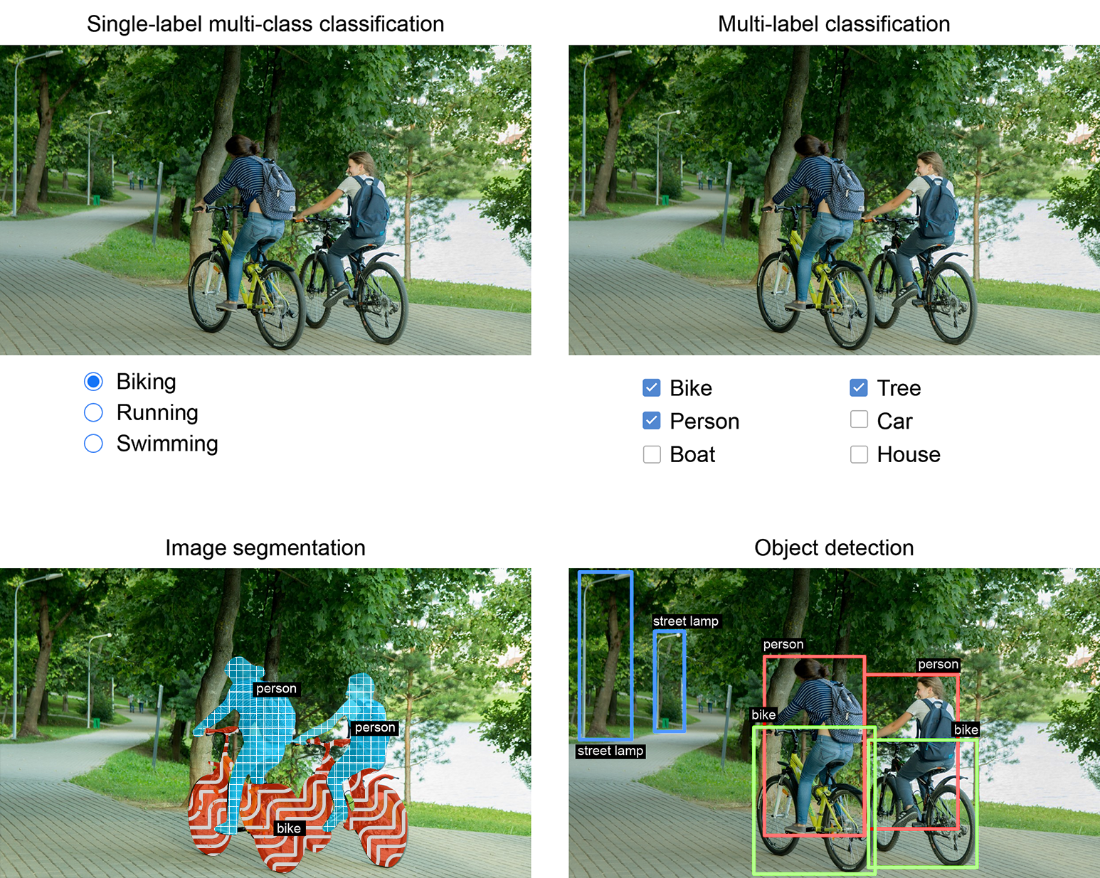
Most practical computer vision systems address one of three foundational tasks:

  • Image classification assigns one or more labels to an image, such as identifying a cat or dog. section 11.1
  • Image segmentation partitions an image into labeled regions with pixel-level precision. section 11.1
  • Object detection draws bounding boxes around objects and associates each box with a class. section 11.1

From photos to autonomous systems

Google Photos can use multi-label classification to answer image searches; video-call backgrounds use segmentation; and autonomous vehicles can use detection to monitor cars, pedestrians, and signs. Vision models also support OCR, robotics, medical diagnosis, retail checkout, and farming. section 8.0 section 11.1

Figure 11.1 The three main computer vision tasks: classification, segmentation, and detection
figure

Compare classification, segmentation, and detection as the three central computer vision tasks. section 11.1


How Deep Learning with R, Third Edition covers it

How deep it goes
Defines three foundational tasks and mentions specialized ones, while deferring detailed convolutional-network architectures and training methods.
Examples
Uses photo search, video-call backgrounds, autonomous driving, OCR, robotics, medical diagnosis, and dogs-versus-cats classification.
What you can do after
Apply convolutional neural networks and pretrained models to image-classification problems and related visual tasks.
How it connects
Connects computer vision to deep learning, convolutional neural networks, image classification, image segmentation, object detection, feature extraction, and fine-tuning.

Also explained in

Compare how 8 books explain computer vision →

Related concepts

This explainer was generated by Manning's knowledge graph from the text of Deep Learning with R, Third Edition. The section links point to the parts of the book it draws on.





