Concurrency lets tasks overlap in time, even when they do not run simultaneously: one task may be interrupted while another proceeds. Parallelism means tasks run at the same time. section 1.3.1 section 3.0
In CPython, the Global Interpreter Lock limits Python threads from executing simultaneously. Overlapping work can still be useful when tasks wait for I/O; asynchronous facilities can serve many concurrent requests without parallel execution. section 1.3.1 section 3.0
Serving concurrent requests
A single-computer MapReduce service can use asynchronous programming to process simultaneous user queries, while concurrent and parallel techniques address the data-processing work. section 3.0
Understanding sequential, concurrent, and parallel models. Sequential execution occurs when all tasks are executed in sequence and never interrupted. Concurrent execution with no parallelism adds the possibility of a task being interrupted by another and later resumed. Parallelism occurs when several tasks are run at the same time. Even with parallelism, it is quite common for preemption to still occur as the number of processors/cores may not be enough for all tasks. A dream scenario is when there are more processors than tasks: this allows parallel execution of all tasks without the need for any preemption.
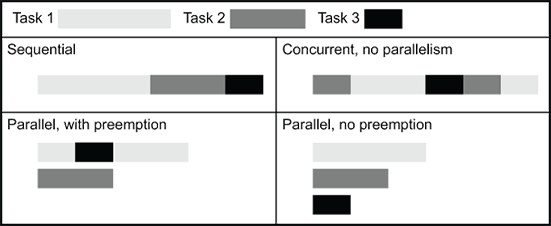
Compare sequential, concurrent, and parallel task execution. section 3.0






















