Conditional independence asks a practical question: once a relevant condition is known, does learning one variable still tell you anything about another? Two events A and B are independent when their joint probability equals the product of their separate probabilities. They are conditionally independent given C when that independence holds after restricting attention to cases with a specified value of C. In shorthand, conditioning can remove an observed correlation rather than merely describe it. section 7.1
Shared train service
Jane and Joe often arrive late on the same days, despite having no relationship with each other. Their common train service explains the pattern: poor service can delay both commuters. Once the service is known to be working well, Jane’s lateness provides no information about Joe’s, so their arrival times are independent given train service. But if they travel together, conditioning on train service would not make their lateness independent; the causal structure matters. section 7.1.1 section 7.1.2
A synthetic example separates the mechanism from the correlation. Choose Z uniformly from 1 through 10, then form X1 and X2 by adding independent small perturbations to Z. Without Z, knowing X1 narrows down where X2 can be, because both sit near the same hidden value. Given the exact value of Z, however, X1 adds no useful information about X2: their remaining variation comes from independent perturbations. section 7.1.2
Figure 7.5 Example of conditional independence. First we choose the value of Z at random. Then we choose X1 and X2 at random, but close to the value of Z. If we know the value of X1, we know that X2 must be close. But if we also know the exact position of Z, the position of X1 does not provide any useful information.
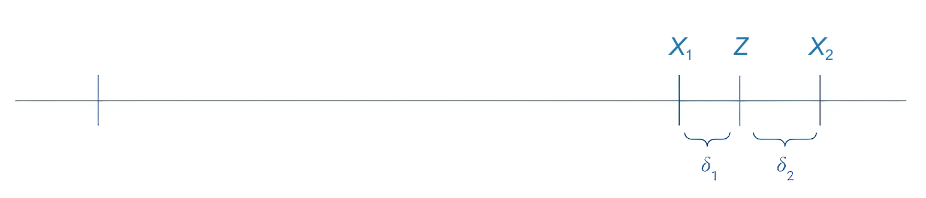
This diagram makes the distinction visible: X1 and X2 move together through their shared dependence on Z, while their deviations remain separate once Z is fixed. section 7.1.2
Conditional independence is statistical, but directed acyclic graphs (DAGs) can imply it before any data are inspected. In a chain or fork, conditioning on an intermediate or common-cause variable can block the path that carries association. The graph-based criterion is d-separation: a set of variables d-separates X and Y when conditioning on that set blocks all relevant paths between them. This links a graph’s structure to independence claims for probability distributions compatible with that DAG. section 7.1.2 section 7.1.6
Conditioning is not automatically a way to remove correlation:
- Conditioning on a variable in a chain can block association along that path. section 7.1.6
- Conditioning on a common cause in a fork can block a potentially spurious association between its descendants. section 7.1.6
- Conditioning on a collider can open a correlation path that was previously blocked; conditioning on a collider’s descendant can do so as well. section 7.1.4 section 7.1.6
Why conditioning can mislead
Two independent dice outcomes X and Y remain unrelated until attention is restricted to cases where their sum Z equals 5. Then seeing X = 2 fixes Y = 3. Here Z is a collider: conditioning creates a negative relationship rather than removing one. A similar selection effect appears when GPA and SAT scores are examined only among admitted students, where conditioning on acceptance can change their correlation. section 7.1.4 section 7.1.4
For causal questions, the point is not to condition on every available variable. When estimating a treatment’s effect on an outcome, use the DAG to identify paths that should be blocked and avoid variables that may open new ones. Conditional-independence claims are guarantees across distributions compatible with a DAG; failure of a graph to guarantee independence does not mean dependence must occur in every compatible distribution. section 7.1.4 section 7.0

