Continuity describes a function that has no excluded input points within its intended domain and no abrupt changes in output. The sine function is continuous, while tangent has excluded inputs and floor changes by jumps despite being defined everywhere. This makes continuity especially useful when modeling curves and surfaces. section 2.4.1
Use these comparisons to test the idea:
- Sine accepts its inputs without breaks and changes smoothly; tangent excludes points such as π/2 + iπ. section 2.4.1
- Floor accepts every real input but returns truncated integer values, producing abrupt jumps. section 2.4.1
- Continuity applies to real-valued functions; it is not treated as a property over integers in the exercise solutions. section 2.7
Spline degree controls a trade-off between smoothness and the number of curve segments. First-degree NURBS form continuous but nonsmooth polylines; second-degree NURBS provide C1 continuity, third-degree provide C2, and fourth-degree provide C3. With N control points and degree M, the pattern yields N−M segments and C(M−1) continuity. section 7.3.1
Figure 7.21 NURBS of degrees 3 and 4 on the same data set as before. When raising the degree, we trade the number of segments for continuity.
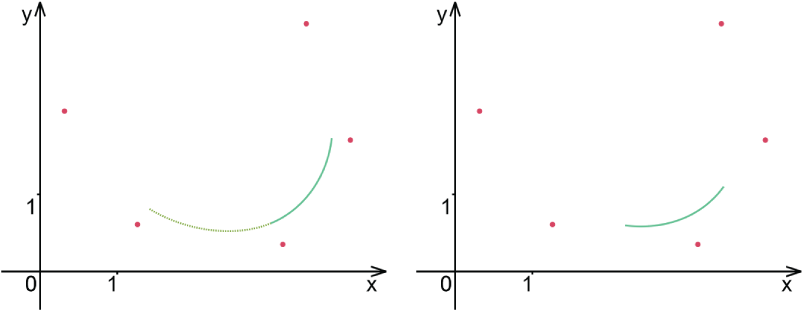
Compare third- and fourth-degree NURBS on the same control data to see continuity increase while available segments decrease. section 7.3.1

