A coordinate change converts data into a new representation where the task becomes easier. Instead of separating points with a complicated rule, choose coordinates that expose a simple boundary. section 1.4
Separating black and white points
Suppose points are labeled black or white in an (x, y) system. A hand-designed coordinate change can make the classes separable by one threshold: black points have x > 0, while white points have x < 0. The transformation supplies the useful representation; the threshold supplies the simple rule. section 1.4
Reading a clock
Extract the tips of the clock hands as Cartesian coordinates, then change those coordinates to polar form around the image center. The resulting hand angles can make time recognition simple enough for rounding and dictionary lookup, without machine learning. section 5.4.2
Use these practical rules:
- Designing a useful coordinate change by hand requires understanding the problem; digit-image rules based on loops or pixel histograms can be effective but brittle. section 1.4
- Treat coordinate changes as feature engineering: organize the data so its underlying structure becomes smoother, simpler, and easier to learn. section 5.4.2
Figure 1.4 Coordinate change
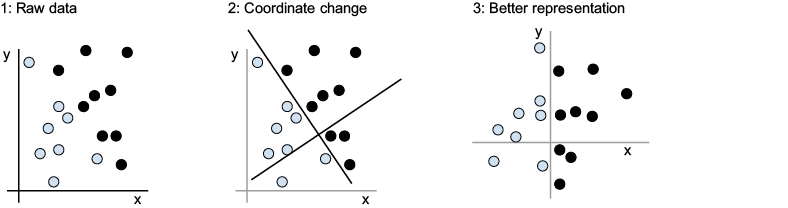
Use the coordinate-change figure to compare the original point arrangement with its more useful representation. section 1.4

