A coordinate change transforms points into a different coordinate system so that the underlying task becomes easier. For black-and-white point classification, a suitable change can turn a complicated boundary into the simple rule “black points have x > 0” and “white points have x < 0.” section 1.4
Reading a clock
Suppose an image contains a clock face. First, extract the (x, y) coordinates of each clock hand’s tip. Then change those Cartesian coordinates into polar coordinates centered on the clock. The resulting angles make the problem simple enough for rounding and dictionary lookup to recover the approximate time, without machine learning. section 5.4.2
Coordinate changes are a form of feature engineering: they express data in a simpler, better-organized form. They can make a classical machine-learning problem easy, but designing useful transformations requires understanding the problem. Modern neural networks can often learn useful representations automatically, reducing the need for manual transformations. section 5.4.2 section 1.4
Figure 1.4 Coordinate change
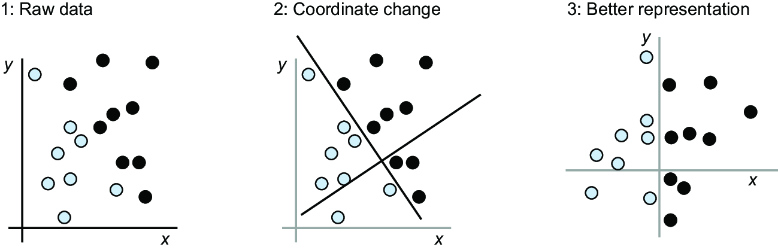
Visualizes how the same points become easier to separate after changing coordinates. section 1.4
Figure 5.17 Feature engineering for reading the time on a clock
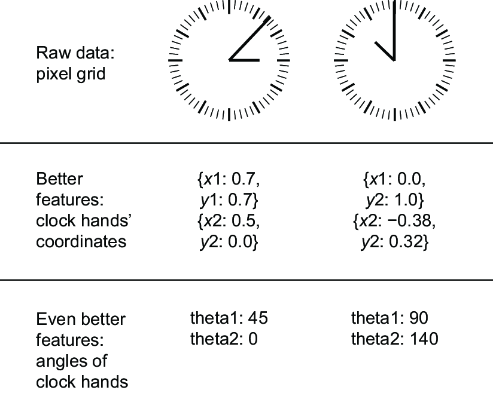
Illustrates coordinate change as a feature-engineering step for recognizing clock times. section 5.4.2

