Coreference resolution determines which entity a referring expression, such as a pronoun, denotes. WinoGrande tests this by asking a model to choose which of two entities fills a sentence’s blank. section 4.3.3
For depth-pruning analysis, WinoGrande examples are formatted with the sentence, candidate entities, and correct answer. Hooks capture each model block’s inputs and outputs; cosine similarity between them contributes to a block-importance score. section 4.3.3
WinoGrande sentence
“Ian volunteered to eat Dennis’s menudo after already having a bowl because _ despised eating intestine.” The options are Ian and Dennis; the answer is Dennis. section 4.3.3
Figure 4.5 In the block evaluation pipeline, hooks are registered, a forward pass of the model is executed using the dataset, and the activations are captured to calculate the block importance. The result is a list containing the block identifier with the assigned importance.
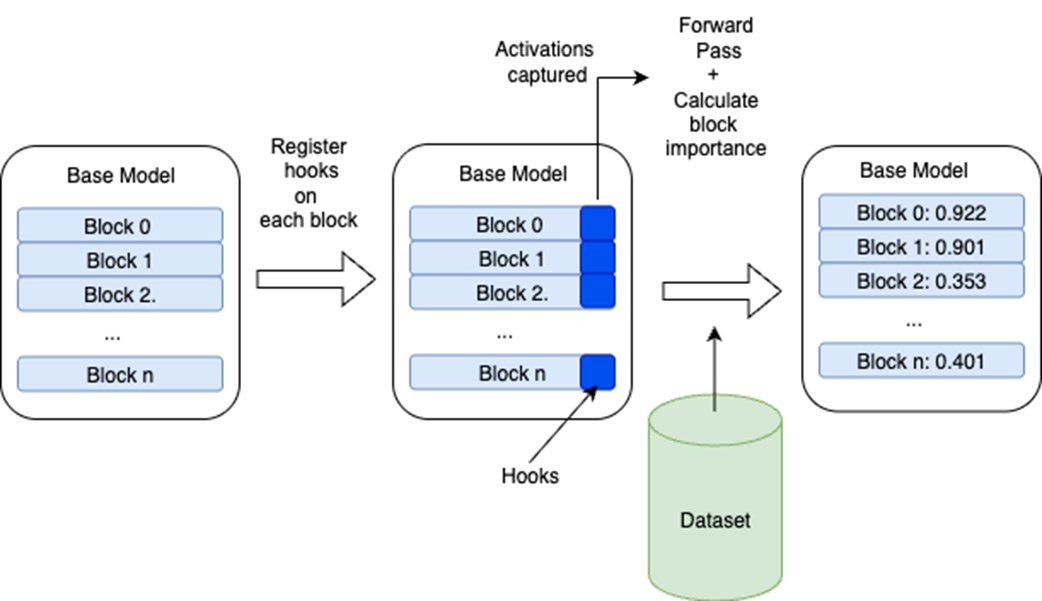
Shows how registered hooks, a model forward pass, and captured activations produce block-importance scores. section 4.3.3



