Cross-fitting separates model training from the predictions used for causal estimation. Rather than letting a model predict the same observations it learned from, split the data: fit on one portion and predict on the held-out portion. This guards against a flexible model fitting noise in the historical data and carrying that overfitting into an estimated causal effect. section 4.2.5 section 4.6
In two-fold cross-fitting, divide the data into D1 and D2. Train on D1 and make the needed counterfactual or nuisance predictions for D2; then reverse the roles. Combine the two held-out results, such as by averaging fold-specific ATE estimates. For k-fold cross-fitting, train on the complement of each fold, predict within that fold, and average across folds. section 4.2.5 section 8.1.3
Table 4.5 The difference between training and predicting on the same dataset with respect to applying cross-fitting
|
Training + predicting
|
Cross-fitting
|
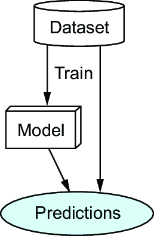
Training and predicting on the same dataset can lead to overfitting, even when using cross-validation.
|
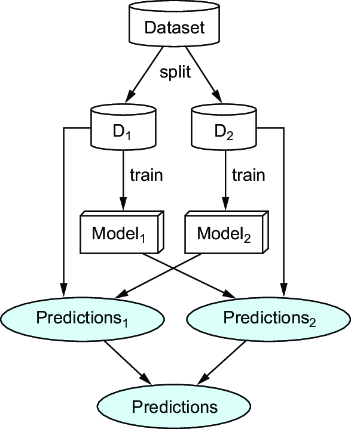
Two-fold cross-fitting trains on one dataset but predicts on the other. Cross-fitting avoids overfitting on the same dataset.
|
The key distinction is not merely tuning a model well: causal predictions must be made on observations that were excluded from that model’s training data. section 4.2.5
A practical two-fold workflow is:
- Split observations into two similarly sized folds; when treatment is binary, keep treatment proportions balanced across folds. section 4.2.5
- Within each training fold, tune and fit the predictive model or models required by the causal estimator. section 5.3.2 section 5.4.1
- Generate predictions only for the opposite held-out fold, then switch fold roles. section 4.2.5
- Compute the causal quantity from held-out predictions and combine results across folds. section 4.2.5 section 8.1.3
Propensity scores for patient data
To estimate propensity scores, train a treatment-prediction model on D1 and score patients in D2; train another model on D2 and score patients in D1. Each patient’s propensity score therefore comes from a model that did not train on that patient. Compare this result with same-data predictions, whose AUC can look better than the cross-validated AUC because of overfitting. section 5.3.2 section 5.4.1
Cross-fitting complements, rather than replaces, causal design. Cross-validation can select predictive hyperparameters, but it does not by itself prevent same-data causal predictions. Cross-fitting also does not resolve confounding: machine-learning adjustment still depends on including the relevant confounders. section 4.6 section 8.1.3
The same split-and-switch pattern works with S-learners, T-learners, propensity-score adjustment, and Double Machine Learning. In DoubleML, k-fold cross-fitting can be requested with n_folds = k; tuning strategy still matters because tuning before the fold procedure can be faster but potentially biased. section 4.2.5 section 8.1.3
