A T-learner estimates causal effects by fitting two separate outcome models: one for treatment X = 1 and another for X = 0. Applying both models to the same covariates produces two potential-outcome predictions; their difference estimates each observation’s treatment effect, and averaging those differences estimates the ATE. section 4.2.4 section 5.4.1
A practical T-learner workflow is:
- Split historical observations by treatment value and train one outcome model on each group, using the available confounders. section 4.2.4
- For every observation, predict the outcome twice—once under X = 1 and once under X = 0—and subtract the predictions. section 5.4.1
- Average the resulting treatment-effect vector to estimate the ATE, while checking whether model fitting and prediction reuse the same data. section 4.2.4 section 4.2.5
Two-fold cross-fitting
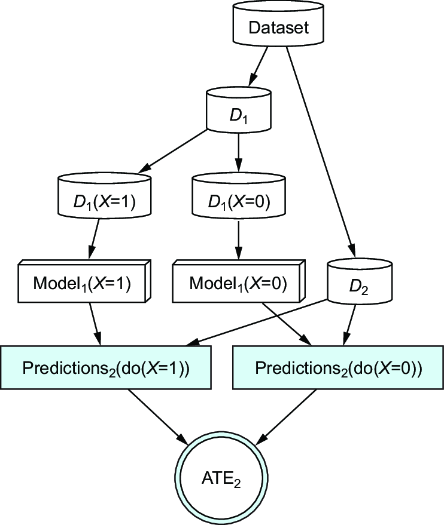
Split the data into D1 and D2. Train treatment-specific models on D1, predict both treatment outcomes for D2, and calculate its treatment-effect vector. Reverse the roles of D1 and D2, then combine the estimates. In an exercise, treatment is RHC versus non-RHC and the outcome is death. section 5.4.1 section 4.2.5
Figure 4.7 Two-fold cross-fitting applied to the T-learner. We split the dataset into two and use one part to train two models with X = 0 and X = 1, respectively. In the other part, we make two interventional predictions (do(X = 0) and do(X = 1)) using both previous models and calculate the ATE. Finally, we switch the roles of the two datasets.
Compare the training and prediction halves of two-fold cross-fitting for a T-learner. section 4.2.5
