Root-n consistency means that an estimator approaches its target at a rate proportional to 1/√n, where n is the sample size. Larger samples therefore reduce estimation error, although the improvement slows as n grows. section 8.1.2
The rate becomes intuitive through comparison:
- The sequence 1/n approaches zero faster than 1/√n; higher powers of n produce faster convergence. section 8.1.2
- The sample mean is a reference point: the central limit theorem gives it a 1/√n rate, and its efficiency means unbiased estimators cannot improve on that rate. section 8.1.2
- DML achieves root-n consistency under reasonable assumptions, while S-learners and T-learners converge more slowly. section 8.1.2
A favorable DML rate
Suppose an estimator uses samples of sizes n, 4n, and 9n. A root-n rate scales its convergence terms as 1/√n, 1/(2√n), and 1/(3√n). This is considered fast because it matches the sample mean’s central-limit-theorem rate. The result is favorable, but the formal DML proof depends on assumptions and advanced mathematics. section 8.1.2
Figure 8.4 Convergence rate for sequences 1/n and 1/√n. We can see that 1/n converges faster to 0 than 1/√n. The convergence rate of an algorithm tells us how fast this algorithm converges to its objective. In statistics and machine learning, the faster an estimate converges, the less data we need.
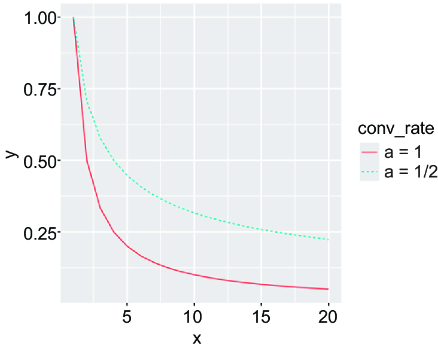
Visualizes why 1/n converges faster than 1/√n and why faster convergence can require less data. section 8.1.2
