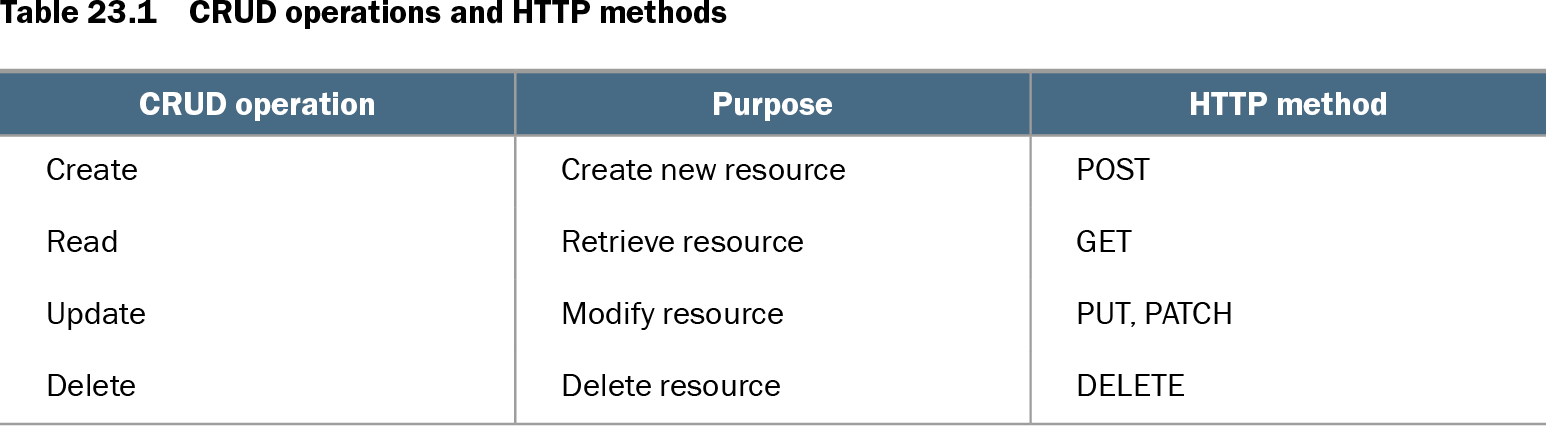
CRUD names the four basic actions for manipulating a resource: create, read, update, and delete. The client identifies the target with a URI and specifies the desired action with an HTTP method. section 23.2.1 section 23.4
Map common HTTP methods to CRUD actions:
- Create a new resource with POST. section 23.2.1
- Read or retrieve a resource with GET. section 23.2.1
- Update a resource with PUT or PATCH; PUT replaces it, while PATCH modifies it. section 23.2.1
- Delete a resource with DELETE. section 23.2.1
Table 23.1 CRUD operations and HTTP methods (view table figure)
| CRUD operation |
Purpose |
HTTP method |
|---|---|---|
| Create |
Create new resource |
POST |
| Read |
Retrieve resource |
GET |
| Update |
Modify resource |
PUT, PATCH |
| Delete |
Delete resource |
DELETE |
Use the mapping table to review each CRUD operation and its corresponding HTTP method. section 23.2.1