CRUD names the four persistent-data operations: create, read, update, and delete. In a board-game web API, these operations let application services interact with database records without exposing the database directly. section 5.0 section 1.1.2
Map each CRUD operation to its database query and typical HTTP method:
- Create uses INSERT and commonly handles HTTP POST requests. section 5.0
- Read uses SELECT and commonly handles HTTP GET requests. section 5.0
- Update uses UPDATE and commonly handles HTTP PUT requests. section 5.0
- Delete uses DELETE and commonly handles HTTP DELETE requests. section 5.0
Implement these operations through EF Core and LINQ rather than writing raw SQL. Inject ApplicationDbContext into controllers, then use IEnumerable<T> for in-memory collections and IQueryable<T> to build queries translated for the database. section 5.0 section 5.7
Seeding board-game records
A create workflow can read a CSV file with CsvHelper, map each record to a DTO, construct BoardGame entities, and add them through ApplicationDbContext. After executing the workflow, the database contains records that read, update, and delete actions can manage. section 5.7
Figure 1.3 Several board-game-related web applications and services fed by a single MyBGList web API
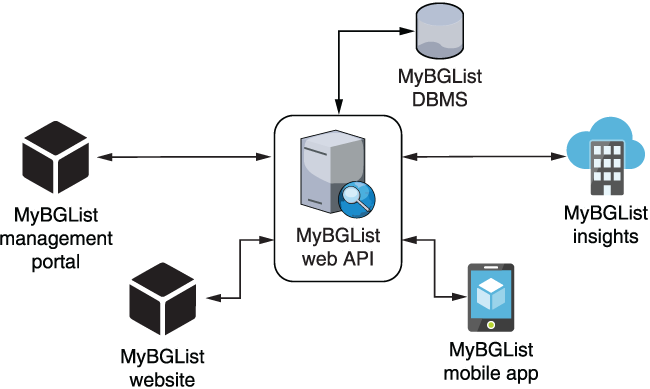
Trace how one web API feeds a public website, mobile app, management portal, and analysis service while keeping the database behind the API. section 1.1.2










