Culture becomes visible through recurring behavior across a group. When people repeatedly blame other departments instead of examining their own actions, the pattern may reflect organizational or team culture. section 5.1.1
A fractal pattern repeats across time and organizational scale. The same accusations may appear between individuals, teams, departments, and management, revealing a shared way of working rather than an isolated incident. section 5.1.1
Observe before interpreting
During a meeting, record observable behavior such as “Julia interrupts others three times” or “Julia interjects when the topic is X.” Separate those notes from interpretations about her motives, then check whether similar behavior appears elsewhere in the organization. section 5.1.1
Figure 5.2 A fractal triangle pattern. This triangle is repetitive at every scale. The big triangle comprises three smaller triangles. Those smaller triangles comprise three even smaller triangles. You’ll find fractal patterns also in companies. Patterns exhibited by higher management will be observable on lower levels of the company.
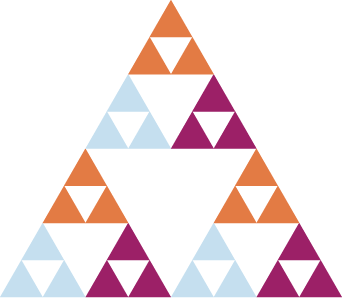
Use the fractal triangle as a visual reminder to look for repeated behavioral patterns at multiple organizational scales. section 5.1.1




