DALL-E
DALL·E is a family of OpenAI generative models that creates images from natural-language descriptions and other conditioning inputs.
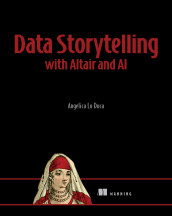
Data Storytelling with Altair and AI
A generative AI system that creates and edits images from textual descriptions or image-editing instructions.
- How it is used
- Adds generated visual context, annotations, and call-to-action icons to data stories.
- How deep it goes
- Defines text-to-image prompting and demonstrates generation, selection, editing, remote hosting, and Altair placement; defers advanced image techniques.
- Examples
- Uses athlete cartoons, homelessness photos, animal images, and black-and-white customer-experience and dollar-bag icons.
- What you can do after
- Apply it to create, select, refine, and place prompt-generated images in Altair data stories.
Read how Data Storytelling with Altair and AI explains DALL-E →
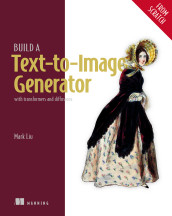
Build a Text-to-Image Generator (from Scratch)
A text-to-image generative model that produces images conditioned on natural-language descriptions.
- How it is used
- Generates images from natural-language prompts through transformer-based text encoding, image-token prediction, and visual reconstruction.
- How deep it goes
- Traces training and inference through BART and VQGAN components, including tokenization, prediction, reconstruction, and cross-entropy supervision.
- Examples
- Uses paired image–caption datasets and the prompt “panda with top hat reading a book” with staged token visualizations.
- What you can do after
- Build it from scratch with PyTorch by implementing text encoding, autoregressive image-token prediction, and VQGAN reconstruction.
Read how Build a Text-to-Image Generator (from Scratch) explains DALL-E →
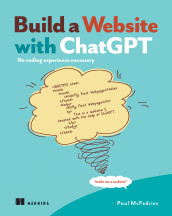
Build a Website with ChatGPT
DALL-E is a generative model that creates images from textual descriptions.
- How it is used
- Supports creating visual assets for online journal pages, including logos, icons, illustrations, and other page imagery.
- How deep it goes
- Explains text-to-image prompting, access options, costs, and limitations, but stops short of model internals.
- Examples
- Demonstrates cartoons, photographs, digital art, and illuminated manuscript pages through concrete prompts.
- What you can do after
- Apply it via the OpenAI DALL-E app or Copilot Image Creator to generate image drafts from detailed prompts.
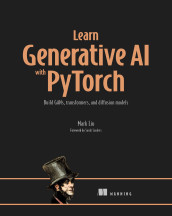
Learn Generative AI with PyTorch
A text-to-image generative model that produces images from textual descriptions.
- How it is used
- Generates images from textual descriptions through text conditioning and diffusion-based denoising.
- How deep it goes
- Explains text encoding, CLIP alignment, and iterative denoising, while using the diffusion model’s internals as the deeper foundation.
- Examples
- Uses astronaut-and-unicorn and cat-at-a-computer prompts with a Python image-generation call.
- What you can do after
- Apply it via the OpenAI Python client to generate and retrieve an image from a text prompt.
Also covered in
- Introduction to Generative AI, Second Edition
- AI for Everyday IT
- Generative AI in Action
- Local Image GenerationIn early access (MEAP)
- The Complete Obsolete Guide to Generative AI
What to know first
- promptA prompt is text or other input supplied to an AI model to provide instructions, context, or other information that guides its response or generated output.
- conversational aiConversational AI is artificial intelligence that enables software systems to interpret user input and interact with users through natural-language dialogue.
- digital imageA digital image is a digital representation of visual content, commonly encoded as an arrangement of pixels or other graphical elements.
- language modelA language model is a computational model that represents patterns in linguistic sequences to assign probabilities, predict, generate, or evaluate language.
Related concepts
- digital imageproduces · A digital image is a digital representation of visual content, commonly encoded as an arrangement of pixels or other graphical elements.
- image generation modelkind of · An image generation model is a machine-learning model that creates, edits, or transforms images from learned patterns and conditioning inputs.
- transformer-based text-to-image modelkind of · A transformer-based text-to-image model generates images from text by modeling relationships between textual and visual token sequences with transformer architectures.
- promptuses · A prompt is text or other input supplied to an AI model to provide instructions, context, or other information that guides its response or generated output.
- CLIPuses · CLIP is a multimodal model and pretraining method that aligns image and text representations in a shared embedding space.
Questions about DALL-E
What is DALL-E?
DALL·E is a family of OpenAI generative models that creates images from natural-language descriptions and other conditioning inputs.
Which Manning books explain DALL-E?
Data Storytelling with Altair and AI, Build a Text-to-Image Generator (from Scratch), Build a Website with ChatGPT and Learn Generative AI with PyTorch.
What should I know before learning DALL-E?
Manning books that teach DALL-E usually introduce prompt, conversational ai, digital image and language model first.
What is DALL-E a kind of?
DALL-E is a kind of image generation model. An image generation model is a machine-learning model that creates, edits, or transforms images from learned patterns and conditioning inputs.
These guides are generated from the text of Manning books by Manning's knowledge graph and link to the sections they draw on. The full books are available on liveBook and at manning.com.