liveBook · Manning

Data ingestion

As explained in First-Party Data Activation

The process of collecting and transferring data from source systems into a storage or processing environment.

Data ingestion brings an organization’s varied data sources into a marketing data lakehouse, creating the foundation for profile management and activation. section 4.2.2

The main forms differ by source and delivery pattern:

  • Event collection streams website, mobile-app, and other engagement data, often in real time, through tools such as GA4, Adobe Analytics, or Twilio Segment. section 4.2.2
  • Batch data ingestion synchronizes backend records, including transactional data, with the marketing data lakehouse using tools such as Fivetran or Matillion. section 4.2.2
  • Collected data may be anonymous, pseudonymous, or personally identifiable, affecting how it can be matched and activated. section 4.2.2
Figure 4.2 Architecture diagram for a marketing stack
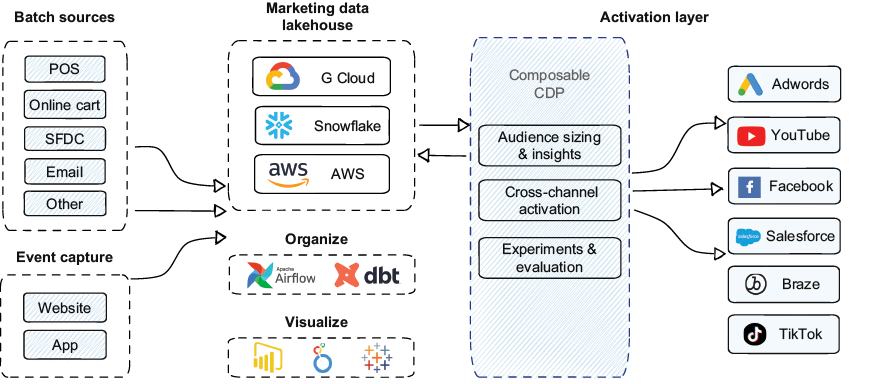
A diagram of a marketing data

AI-generated content may be incorrect.

Use the marketing-stack architecture to trace data from collection and ingestion through customer profile management to activation. section 4.2.2


How First-Party Data Activation covers it

How deep it goes
Distinguishes event and batch ingestion at an architecture level, without detailing implementation workflows.
Examples
Uses GA4, Adobe Analytics, Twilio Segment, AWS S3, Google Cloud Storage, Fivetran, and Matillion as concrete examples.
What you can do after
Evaluate ingestion choices by source type, delivery pattern, data identity, and downstream activation needs.
How it connects
Links event collection and batch data ingestion with marketing data lakehouses, customer profile management, and activation.

Also explained in

Compare how 6 books explain data ingestion →

Related concepts

This explainer was generated by Manning's knowledge graph from the text of First-Party Data Activation. The section links point to the parts of the book it draws on.



