A grocery store can use purchase data to decide what to stock, where to place products, and which promotions to offer. Data mining supports such decisions by using algorithms to uncover patterns, relationships, anomalies, and useful insights in large, complex datasets. section 3.1
Data mining includes tasks such as classification, prediction, clustering, and market basket analysis. Its algorithms use statistical, probabilistic, and mathematical techniques; some can produce human-readable explanations of what they find. section 3.1 section 3.8
Purchases that occur together
Market basket analysis looks for products that tend to be purchased together. In a dataset of one million receipts, 20,000 include bread and cheese, and 5,000 include bread, cheese, and olives. Such counts can inform decisions about product placement or promotions. section 3.2 section 3.1
A fraud-prevention model can use a decision tree to classify transactions. Beyond the original transaction records, it may use derived attributes, such as the number of transactions in the last hour. A tree’s logic can also be translated into if-then-else rules. section 3.2
A data mining project generally proceeds iteratively:
- Define the application domain and project goals; gather, integrate, and clean the data. Labeling may be costly. section 3.2
- Identify useful derived attributes, split data into training and testing sets, and select suitable algorithms. section 3.2
- Train and test the model, including its scalability and resilience. For a decision tree, prune it to keep it sufficiently general. section 3.2
- Repeat the relevant steps until performance is satisfactory, then deploy and integrate the model into operations. section 3.2
Figure 3.2 An example of a flowchart that depicts the various steps to design and deploy a data-mining model
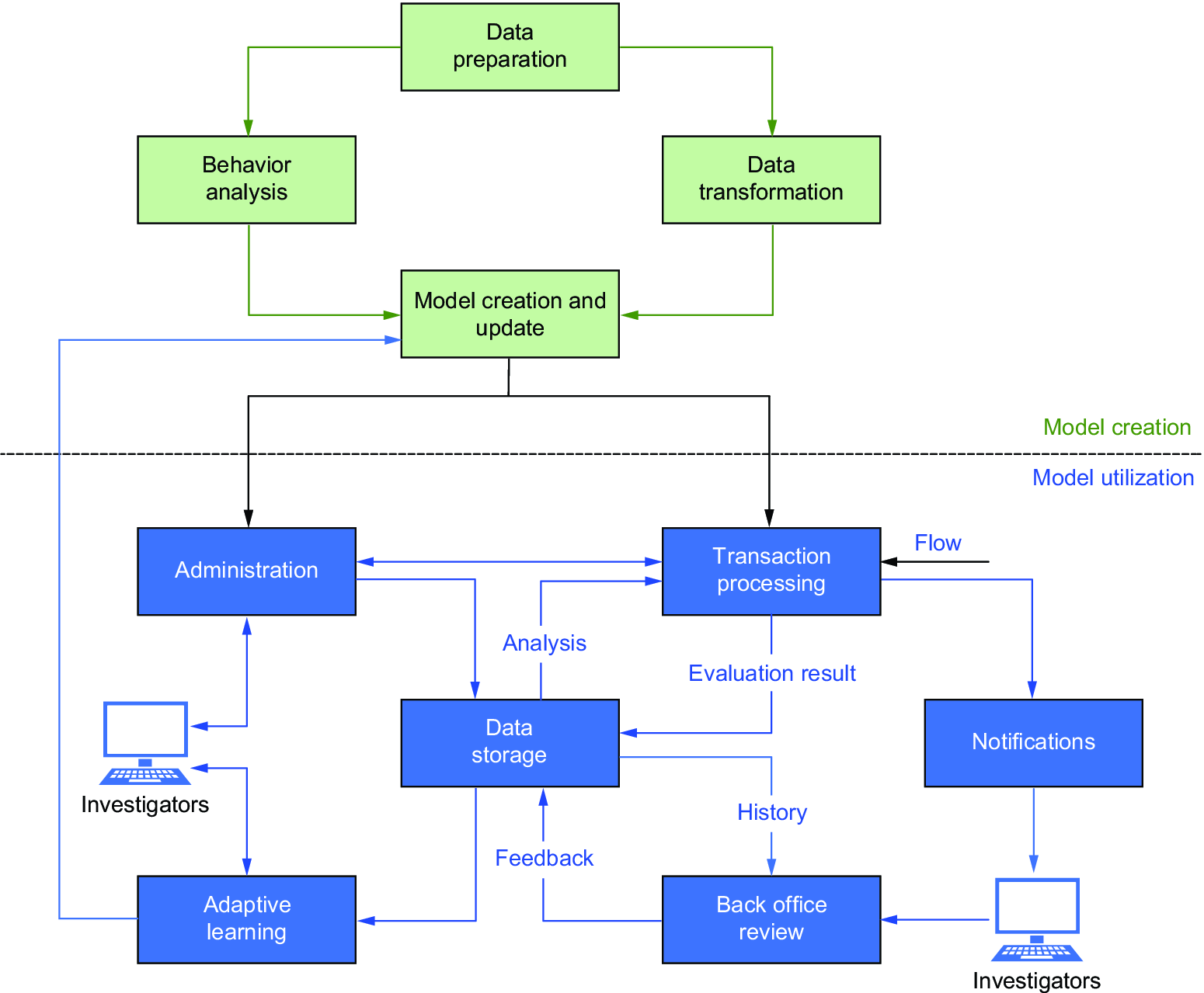
The flowchart maps the steps from designing a data mining model through deployment. section 3.2
No single technique addresses every need. In fraud prevention, data mining can identify patterns while other techniques address historical cases, uncertainty, or decision rules. Useful results depend on preparation, testing, and integration—not merely on having a large dataset. section 11.7 section 3.2



