A data plane is the request-time part of a distributed system. It runs as SDK runtime code inside each workflow container, receives HTTP requests, invokes workflow functions, coordinates platform-service calls, and returns responses. Deployment, scaling, health monitoring, and route registration belong to the separate control plane. section 9.0 section 9.8
A production data plane typically handles:
- Request translation: discovers the workflow through WORKFLOW_NAME, deserializes JSON bodies into keyword arguments, and serializes return values into JSON. section 9.8
- Response execution: runs synchronous functions with timeouts, streams generator output through Server-Sent Events, or returns asynchronous job IDs while work continues in a background thread. section 9.8
- Platform coordination: calls sessions, models, data, and other services through the API Gateway, with retries and exponential backoff for transient network failures. section 9.0 section 9.8
- Request isolation: creates separate platform instances and copied context variables for concurrent requests, preventing trace and state cross-contamination. section 9.8
Stateless research workflow
An asynchronous research workflow fans out searches across company knowledge, engineering documentation, and the web, merges the results, and synthesizes them with a model call. The data plane returns a job ID immediately while child workflows run in independently scalable containers. Sessions, memory, knowledge bases, and credentials remain in platform services, allowing horizontal scaling. section 10.12
Figure 9.1 Control plane vs. data plane. On the left, the Workflow Service (control plane) connects to Kubernetes to manage container Deployments and to the API Gateway to register routes. On the right, the data plane: multiple workflow containers, each running the SDK's runtime server, receiving HTTP requests from the API Gateway and making gRPC calls to platform services through the gateway. For synchronous and streaming workflows, the control plane and data plane do not communicate during request handling. For asynchronous workflows, the data plane calls the control plane to manage job state.
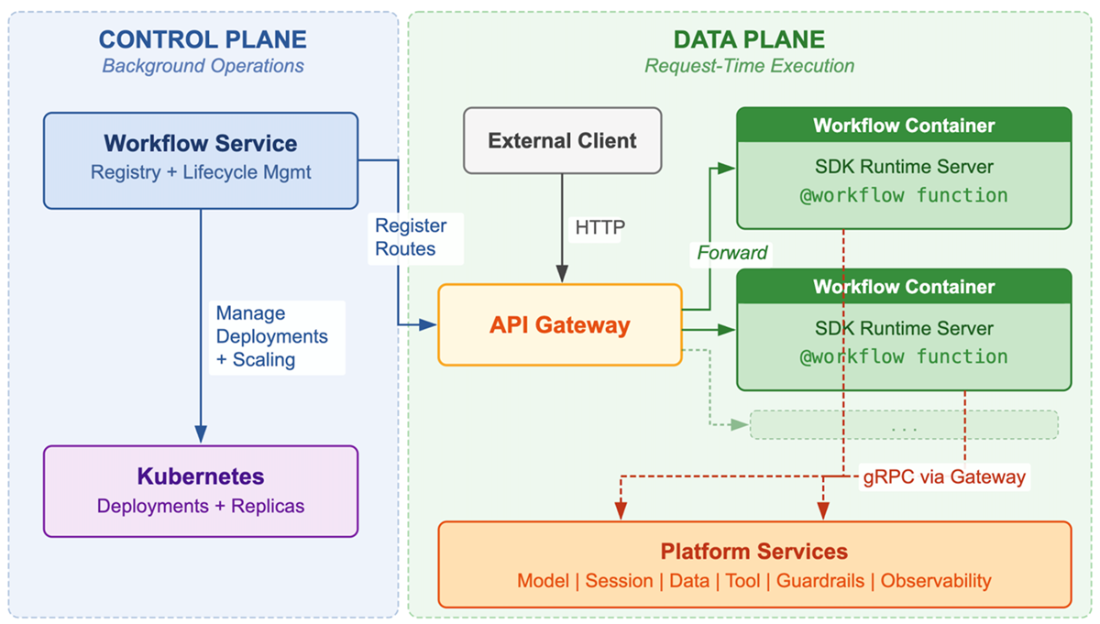
Use the architecture diagram to trace the boundary: the control plane manages Kubernetes deployments and API Gateway routes, while workflow containers receive requests and call platform services. Asynchronous workflows additionally call the control plane for job state. section 9.0




