A deepfake is synthetic or manipulated media created with artificial intelligence to make people appear to say or do things inaccurately or deceptively. The term combines “deep learning” and “fake” and originally described face-swapped videos, especially fabricated depictions of particular people. Its meaning has broadened to include photorealistic fictional people, cloned voices, fabricated recordings, and propaganda-like content. Deepfakes are one part of the wider category of synthetic media, which also includes AI-generated text, images, video, voice, and data. section 4.1
Deepfakes create both creative possibilities and serious social risks:
- Expand access to professional-looking images, video, and audio for creators without large budgets or specialized teams. section 4.3
- Enable impersonation, surveillance, identity theft, privacy violations, political manipulation, and disinformation. section 4.3 section 10.12
- Produce a liar’s dividend: people can dismiss authentic evidence by falsely labeling it a deepfake. section 4.3
- Support protective uses, such as anonymizing activists’ faces while preserving the emotional force of documentary footage. section 4.3
From fabricated announcements to cloned voices
Examples include a fabricated video of President Biden announcing a military draft, a manipulated clip of Mark Zuckerberg, AI-generated explicit images of Taylor Swift, election disinformation using synthetic speech, and cloned relatives’ voices used in WhatsApp scams targeting older people. section 4.1 section 10.12
Figure 4.1 The landscape of synthetic media
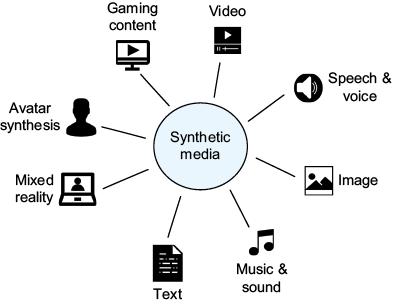
Maps deepfakes within the broader landscape of synthetic media, including generated or modified text, images, video, voice, and data. section 4.1



