Denoising removes unwanted noise from data while preserving meaningful structure. An autoencoder can turn a lightly corrupted input, such as a low-quality JPEG, into a cleaner version of the same image. section 17.2
From noisy image to generated image
Image super-resolution denoises and enlarges low-resolution photographs, but it does not recover hidden details. It makes educated guesses based on learned examples, which can produce convincing but incorrect features. Repeating denoising steps can go further: starting with pure noise, a reverse diffusion process progressively produces a new image. section 17.2
Use these practical rules when interpreting denoised outputs:
- Treat sharp new detail as a prediction, not proof that the input contained that detail. section 17.2
- View diffusion as repeated denoising: each step moves a noisy image toward a structured result. section 17.2
- Condition denoising with text embeddings when the desired image must follow a prompt. section 17.3
Text-to-image diffusion supplies the denoiser with both noisy images and embedded text. During generation, pure noise and a new prompt become an image whose denoising trajectory is guided by that prompt. section 17.3
Figure 17.6 Image super-resolution
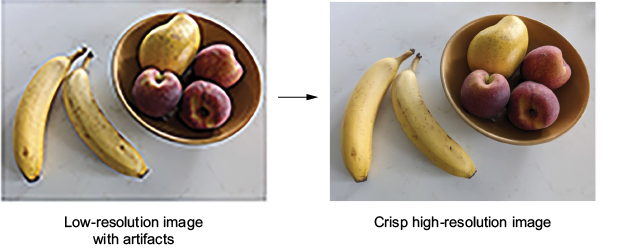
Use the super-resolution figure to compare a low-resolution input with a denoised, higher-resolution result. section 17.2
Figure 17.7 Reverse diffusion: turning pure noise into an image via repeated denoising
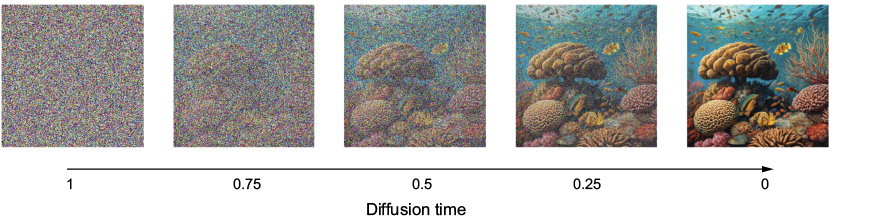
Use the reverse-diffusion figure to follow the progression from pure noise to an image through repeated denoising. section 17.2






