Denoising removes unwanted variation from data to recover a cleaner version. In images, an autoencoder receives a noisy or low-quality input and predicts a cleaned image, often by making informed guesses rather than recovering truly lost detail. section 17.2
A diffusion denoising pipeline follows these main steps:
- Normalize clean images so their value range matches unit-variance, zero-mean noise. section 17.2.4
- Sample diffusion times, calculate noise and signal rates, and add random noise to each image. section 17.2.4
- Predict noise masks, reconstruct denoised images, and train with mean absolute error on the predicted masks. section 17.2.4
- Repeat denoising from pure noise to generate a new image, extending ordinary denoising into reverse diffusion. section 17.2
Super-resolution can hallucinate detail
A smartphone camera may turn a severely blurred, moon-like printout into a crisp image of lunar craters. The model is generating plausible detail learned from moon photographs, so the result should not be trusted for forensics. section 17.2
Figure 17.7 Reverse diffusion: turning pure noise into an image via repeated denoising
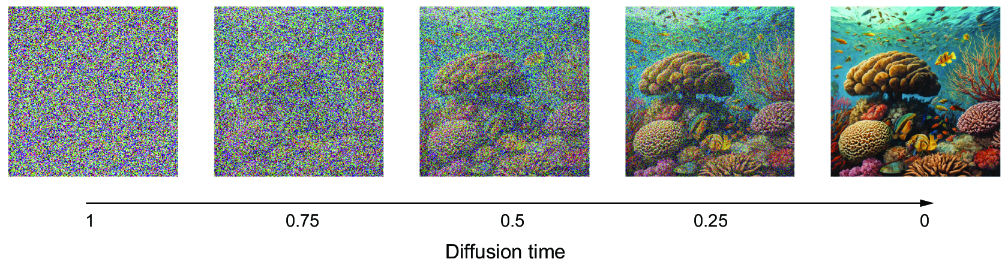
Shows reverse diffusion turning pure noise into an image through repeated denoising. section 17.2






