Dependency injection provides an object with the other objects it needs, instead of having it create them itself. This loosens coupling and makes dependencies easier to replace. section 2.4.3
A report generator shows the difference:
- Tightly coupled: the generator creates its own database connection, so tests depend on a real database. section 2.4.3
- Loosely coupled: the generator receives a database connection in its constructor, so tests can provide a fake. section 2.4.3
Test with a fake dependency
Pass an object with a getData method that returns three test rows to the report generator. Its report logic can then be checked without connecting to a real database. section 2.4.3
Figure 2.7 Loose coupling replaces hardcoded connections with a flexible "Socket" (Interface). This allows the Report Generator to stay stable while you swap in a Fake DB for fast testing or a Real DB for production without changing the core code.
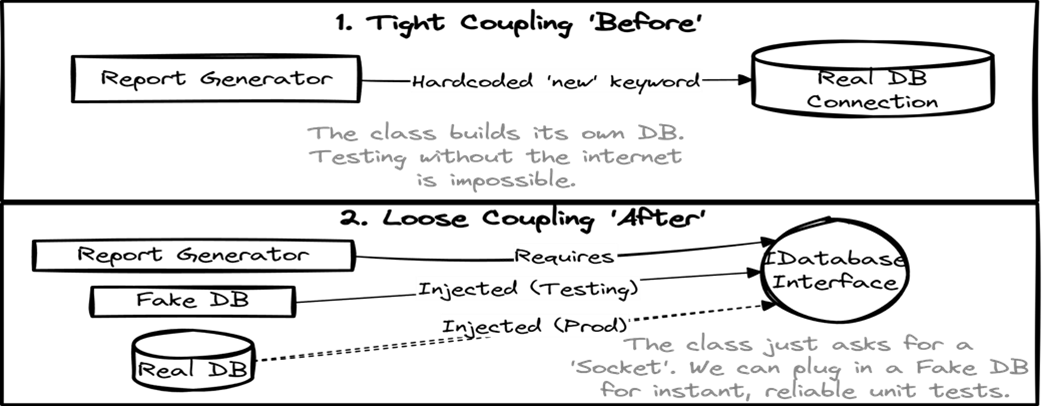
The socket-and-plug illustration shows how a report generator can use a fake database for tests or a real one in production. section 2.4.3
The same pattern lets an OrderService receive a logger that meets a contract rather than calling a specific static logger. In a larger refactor, injected dependencies can help separate responsibilities and improve testability, though that choice takes more upfront work. section 4.5.2 section 3.5.2