liveBook · Manning

Dependency inversion

As explained in AI-Powered Developer: Build software with ChatGPT and Copilot

A software-design principle stating that high-level policy should not depend directly on low-level details and that both should depend on abstractions.

Dependency inversion principle (DIP) keeps high-level modules from depending on low-level modules. Instead, program to interfaces rather than implementations, supporting designs that are more flexible and maintainable. section 3.3 section 3.4

Swappable depreciation calculations

An asset-management model gives FundingDetails a DepreciationStrategy interface. Straight-line, declining-balance, double-declining, and no-depreciation implementations can then be exchanged without making the asset model depend on one calculation method. section 3.3

Figure 3.5 We have added a depreciation strategy to our object model. This introduction allows us to swap out the method by which we can calculate the depreciation of an asset.
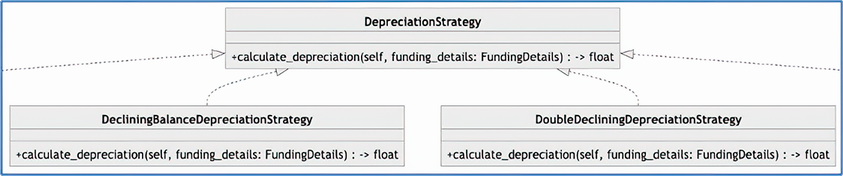
The diagram makes the abstraction and its concrete depreciation strategies visible, showing how calculation behavior can be swapped. section 3.3


How AI-Powered Developer: Build software with ChatGPT and Copilot covers it

How deep it goes
Defines DIP briefly and illustrates it with an interface plus four concrete depreciation implementations.
Examples
Uses an IT asset model where FundingDetails selects among four DepreciationStrategy implementations.
What you can do after
Evaluate/understand designs that replace direct implementation dependencies with interface-based collaborators.
How it connects
Places DIP within SOLID and connects it to interfaces, implementations, and hexagonal architecture.

Also explained in

Compare how 6 books explain dependency inversion →

Related concepts

This explainer was generated by Manning's knowledge graph from the text of AI-Powered Developer: Build software with ChatGPT and Copilot. The section links point to the parts of the book it draws on.



