liveBook · Manning

Dependency inversion

As explained in .NET in Action, Second Edition

The dependency inversion principle is a software design principle in which high-level modules depend on abstractions rather than concrete low-level implementations.

Dependency inversion makes high-level classes depend on abstractions rather than concrete low-level implementations. Calling code or dependency injection chooses the implementation. section 6.2.5 section 7.1

Apply the principle by:

  • Replacing a direct dependency, such as System.Random or DateTime.UtcNow, with an interface. section 6.2.5 section 7.1
  • Accepting the abstraction through a constructor or resolving it through dependency injection. section 7.1
  • Substituting deterministic implementations, mocks, or fakes during tests. section 7.0 section 7.1

Controlling time in a stopwatch

A stopwatch that reads DateTime.UtcNow directly requires Thread.Sleep and can produce slow or flaky tests. BasicStopwatch instead receives ISystemClock; production uses SystemClock, while tests provide exact timestamps and advance them directly. The same design resets and verifies elapsed time without waiting. section 7.1

Figure 6.3 A class diagram of DeckOfCards with a dependency on an interface to perform randomization along with implementations of that interface
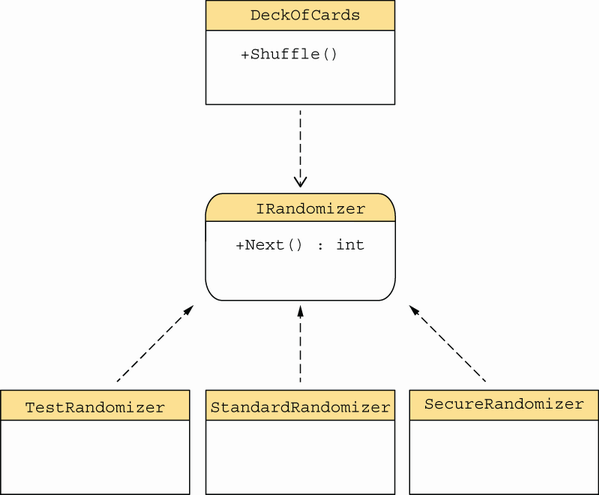
Compare a DeckOfCards class coupled to System.Random with one coupled to a randomization interface and replaceable implementations. section 6.2.5


How .NET in Action, Second Edition covers it

How deep it goes
Explains interface substitution, constructor injection, default implementations, and deterministic fakes through C# examples.
Examples
Demonstrates card shuffling with randomization interfaces and stopwatch timing with an injectable system clock.
What it assumes
Assumes familiarity with C# classes and interfaces while teaching dependency injection through focused examples.
What you can do after
Build it from scratch with interfaces and constructor injection, then test behavior using deterministic implementations.
How it connects
Connects dependency inversion with interfaces, dependency injection, unit testing, mocks, fakes, SOLID principles, and ASP.NET Core.

Also explained in

Compare how 6 books explain dependency inversion →

Related concepts

This explainer was generated by Manning's knowledge graph from the text of .NET in Action, Second Edition. The section links point to the parts of the book it draws on.



