Dependency inversion keeps higher-level code focused on what it needs instead of which class provides it. Define a small interface at the point of consumption, then supply an implementation separately. The consumer depends on required behavior, so implementations can change without changing the consumer. section 9.4 section 8.5
Start with a login requirement
A login page needs to log in; it does not need to know how authentication works. Define IAuthService in the UI project with LoginAsync returning Task<bool>. The button handler calls that interface, disables the button while work runs, displays activity feedback, and handles success or failure. A MockAuthService can initially satisfy the requirement while the real service is built. section 8.1.1 section 8.1.1 section 8.1.1
Figure 8.1 The LoginPage has a login button. This button triggers an event handler in the code-behind file. The event handler doesn’t handle the process of logging in itself; instead, it calls a Login method in an authentication service.
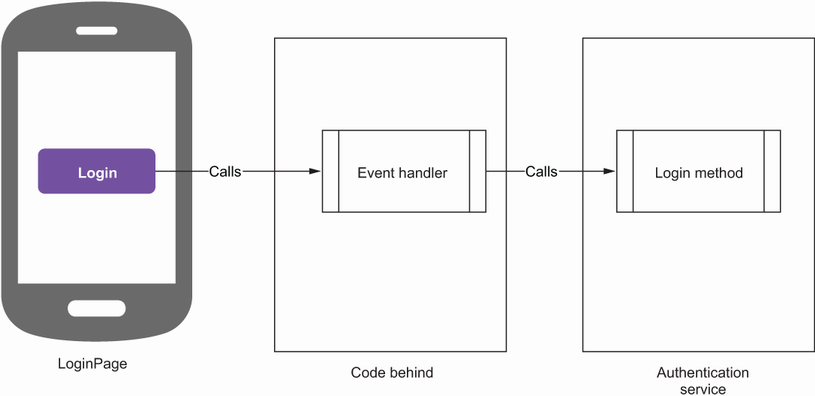
The login flow makes the boundary visible: the event handler delegates authentication to a service rather than performing it itself. section 8.1.1
Inject the interface rather than constructing a concrete service in the page. A constructor such as LoginPage(IAuthService authService) lets the service collection provide a fully resolved implementation, including that implementation’s own dependencies. This avoids coupling the page to a default constructor or a specific authentication class. section 8.2.2 section 8.2.2
Use dependency inversion in a practical sequence:
- Identify the behavior a View or ViewModel needs, such as authentication, product lookup, or inventory updates. section 9.6
- Declare a focused interface containing only that consumer’s needed operations; split larger implementations across interfaces when consumers need different operations. section 9.4
- Build an implementation afterward and register dependencies with the host builder’s service collection. section 9.6 section 9.7
- Receive dependencies through constructors; do not resolve them globally through a service locator. section 8.2.2
- Keep UI, presentation, and business responsibilities separate so an implementation can change behind its interface. section 9.6
The value is loose coupling and easier maintenance. UI appearance can change without rebuilding services, and a REST API can be replaced with GraphQL by changing service implementations while interfaces and other app parts remain intact. MVVM supports this structure by separating View, ViewModel, and Model responsibilities. section 9.6 section 9.7





