Diminishing returns describes a plateau: each additional investment or effort produces a smaller gain than the previous one. Technology often follows an S-curve, with rapid progress slowing as constraints accumulate. section 7.1.1 section 9.2.1
For LLM self-improvement, repeatedly generating data and retraining can reduce quality rather than improve it. Continued progress requires external information, new training data, new techniques, or more capable infrastructure. section 7.1.1 section 9.2.1
The plateau can arise from several kinds of constraint:
- More transistors do not automatically produce proportional gains in frequency, power efficiency, single-threaded performance, or total computing. section 7.1.1
- Power, data, computational capacity, GPU cost, and hosting infrastructure can limit further improvement. section 7.1.1
Moore’s law and the computing plateau
Transistors may continue doubling while overall computing performance fails to double at the same rate. The example separates growth in one measure from improvement in the complete system. section 7.1.1
Figure 9.2 The S-curve, or sigmoid, shows the classic plateau behavior: at some point, you hit diminishing returns. The counterpoint to this expressed by the iterative S-curve model is that progress continues past the plateau of diminishing returns by discovering new techniques, each represented by a new S-curve. The new techniques may start worse than the existing methods but have a higher potential to surpass them.
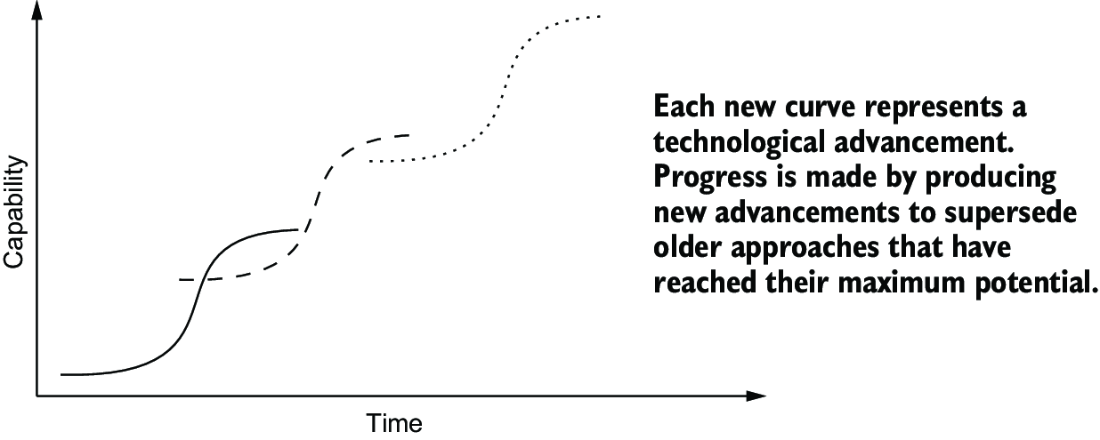
The S-curve figure shows how progress reaches a plateau, while an iterative S-curve model shows how new techniques can begin a fresh period of improvement. section 9.2.1

