An ontology formally represents concepts in a domain and the relationships among them. In healthcare, it preserves clinical meaning as data moves between EHRs, departments, and software systems, so clinicians can interpret and act on information consistently. section 3.0 section 3.1
Ontology connects clinical reality with machine-readable codes, data models, and rules. A universal ontology is impractical: specialties describe different concepts at different granularities, while medicine continually introduces diseases, treatments, observations, and policies. section 3.1 section 3.2
Healthcare systems combine complementary terminologies to represent different parts of the clinical story:
- SNOMED-CT represents diagnoses, problems, findings, and procedures. section 3.5
- LOINC represents observations and questions, including laboratory tests, vital signs, and measurements. section 3.5
- RxNorm represents medication identities for reliable exchange and interpretation. section 3.5
Clinical change exposes ontology limits
COVID-19 required clinicians to distinguish novel patterns such as hypoxemia, MIS-C, and Long COVID, demonstrating why clinical vocabularies must evolve rather than remain fixed. section 3.2
Figure 3.1 Illustrating the vocabulary gap that makes a single universal clinical ontology impossible.
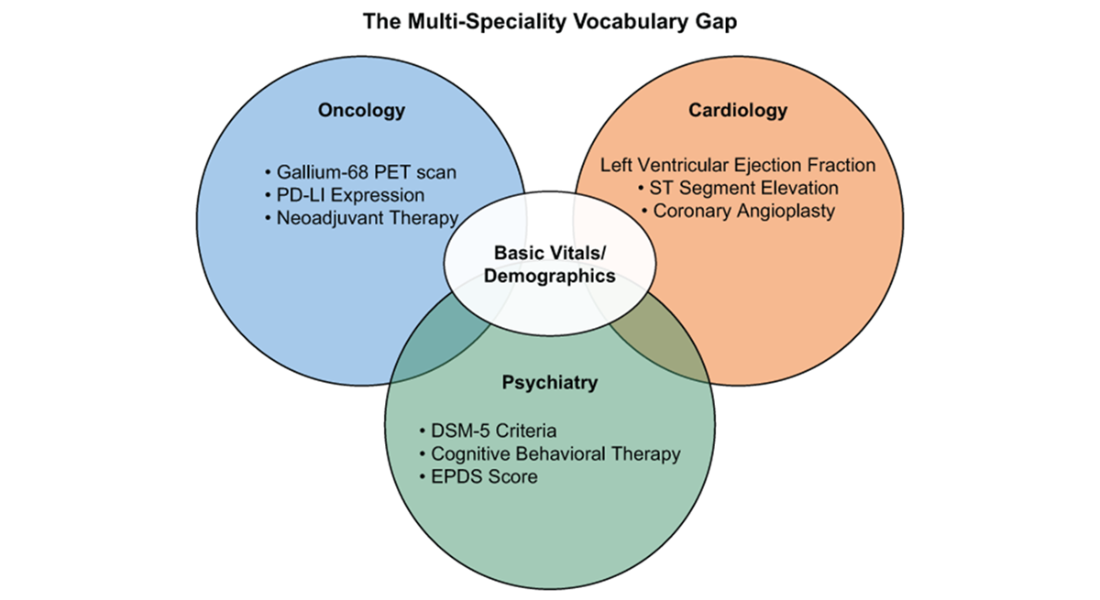
Use the figure to inspect the vocabulary gap between specialties that makes one universal clinical ontology impractical. section 3.2