DRY requires each piece of knowledge to have one unambiguous, authoritative representation. For an algorithm, that means implementing it once rather than copying it across the system. This can reduce design-time coupling: a rule change then has one location to update. section 4.2.4
FTGO order totals
The order total calculation was copied in multiple places while it remained stable. When FTGO added a COVID surcharge, changing the rule meant updating each implementation; a single implementation would need changing only once and avoid inconsistent versions. section 4.2.4
Figure 4.5 Applying the DRY principle replaces multiple implementations of a business rule with a single implementation. As a result, a change only needs to be made in one place, and there’s no risk of bugs caused by inconsistent implementations.
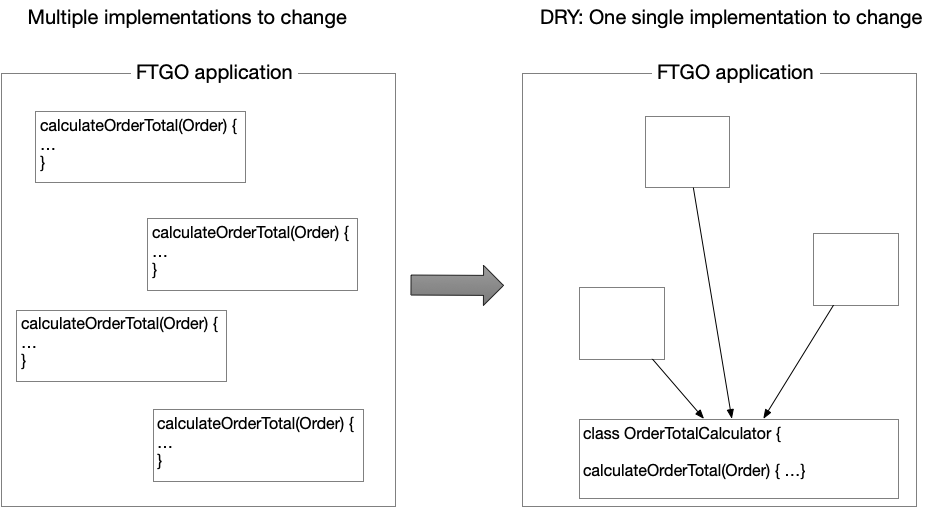
Shows multiple business-rule implementations replaced by one, localizing changes and reducing the risk of inconsistent implementations. section 4.2.4










