liveBook · Manning

Downstream task

As explained in Sutskever's List

A task evaluated after model training to measure practical performance on a particular capability or application.

A downstream task tests a model’s practical capability after training. Training-loss scaling can be predicted precisely, but performance on tasks such as arithmetic, coding, or planning may rise unevenly; general benchmarks offer a better, though limited, view. section 6.2.1

Uneven performance

A model might generate a color-changing American flag but fail to make a cake that plays “Happy Birthday,” or know how to tie one shoe but not the other. Benchmark accuracy can also decline temporarily as models scale before recovering. section 6.2.1

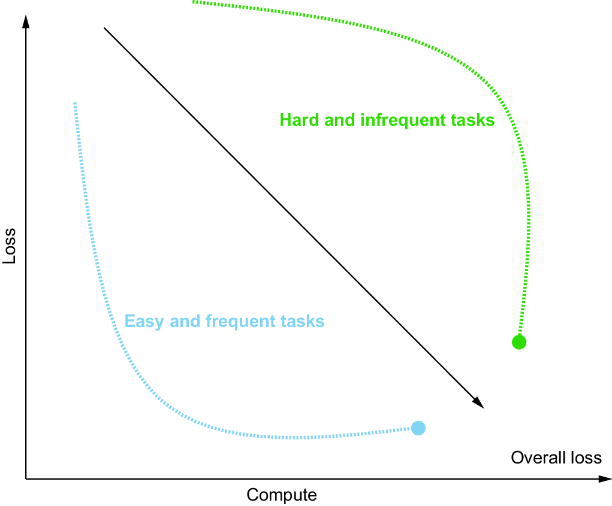
Figure 6.4 A model will learn some tasks more easily than others. Easy tasks are frequent with dense data, while hard tasks are infrequent with sparse data.
figure

Illustrates why tasks may be learned unevenly: easier tasks occur more often in denser data, while harder tasks are less frequent. section 6.2.1


How Sutskever's List covers it

How deep it goes
Contrasts predictable training-loss scaling with uneven downstream performance and notes that benchmarks offer only a partial view.
Examples
Uses arithmetic, coding, planning, mismatched flag-and-cake generation, and right-versus-left shoe tying.
What you can do after
Evaluate model capability with general benchmarks while recognizing that loss forecasts do not guarantee task performance.
How it connects
Connects scaling laws, training loss, general benchmarks, and inverse scaling.

Also explained in

Compare how 3 books explain downstream task →

Related concepts

This explainer was generated by Manning's knowledge graph from the text of Sutskever's List. The section links point to the parts of the book it draws on.
