Dynamic routing lets routers exchange reachability information through routing protocols and automatically build routing tables, instead of requiring an administrator to configure every route. Routers advertise known networks to one another, improving adaptability and scalability as the network changes or grows. section 17.1 section 17.1.1 section 17.1.2
Dynamic routing connects to several important routing ideas:
- Adaptability: routers can remove failed paths and calculate replacement routes, reducing downtime when links fail or recover. section 17.1.1
- Scalability: routing protocols reduce the time and human error involved in configuring routes across larger networks. section 17.1.2
- Protocol categories: Interior Gateway Protocols exchange routes within one autonomous system, while Exterior Gateway Protocols exchange routes between autonomous systems. section 17.2
- Algorithm categories: distance-vector protocols include RIP and EIGRP; link-state protocols include OSPF and IS-IS; BGP uses a path-vector algorithm. section 17.2 section 17.5
- Dynamic and static routing can coexist: dynamic routing supplies adaptability, while static routing can provide predictability and control over a chosen path. section 17.1.2 section 17.5
Route selection has two distinct meanings. During routing-table population, the router uses administrative distance and metrics to choose among routes to the same destination. During packet forwarding, it chooses the most specific matching route already in the table. Overlapping prefixes such as /24, /25, /26, and /27 can therefore all enter the table, while the packet uses the prefix with the longest matching length. section 17.3.3 section 9.4
Recovering from a failed link
Suppose R1, R2, and R3 exchange routes dynamically, and the R2–R3 link fails. R2 removes its route through R3 and learns an alternate path through R1; R1 removes its route through R2 and selects a path through R4. Within seconds, the routers can reflect the changed topology in their routing tables. An EIGRP-learned route appears with the code D in the routing table. section 17.1.1
Figure 17.1 R1, R2, and R3 use a routing protocol to share routing information with each other. Each router will use this information to build its routing table.
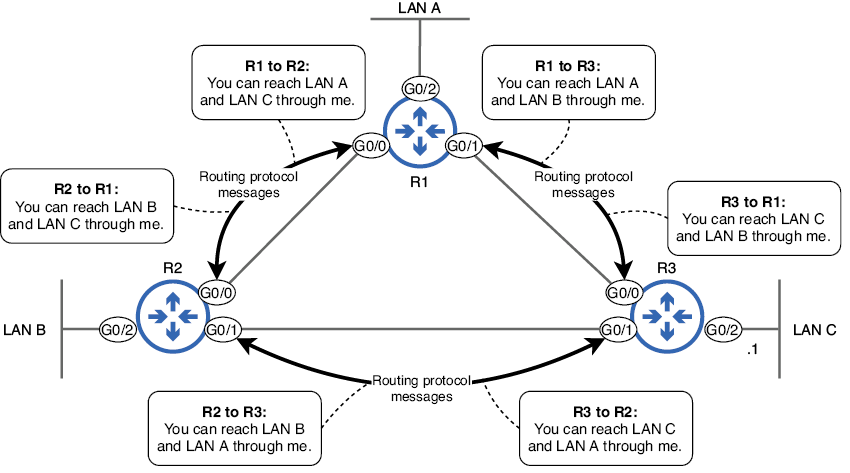
Trace how neighboring routers advertise known networks and use the exchanged information to build their routing tables. section 17.1


