An edge is a graph element representing a relationship between two nodes. Nodes represent entities such as terms, people, places, things, or concepts; edges connect those entities. section 5.1
Edges make knowledge graphs traversable. Following connected edges can combine known relationships to infer additional facts, such as connecting authors, a paper, a conference, and its location and date. section 5.1
In a semantic knowledge graph, an edge can be materialized from search results. Two nodes are represented as document sets, and their edge is the set of documents containing both nodes. A relationship phrase can define a more specific edge type. section 5.4.7
Traversing a relationship edge
Starting with "jean grey" and the relationship phrase "in love with", an SKG traversal combines both contexts and returns related terms such as "summers", "cyclops", and "wolverine". This models traversal through an "in love with" edge without requiring a manually stored graph edge. section 5.4.7
Figure 5.1 A graph structure. Graphs are composed of nodes (also known as “vertices”) that represent entities and of edges that represent a node’s relationship with another node. Graphs provide a way to model knowledge and infer new insights by traversing (or “following”) the edges between nodes.
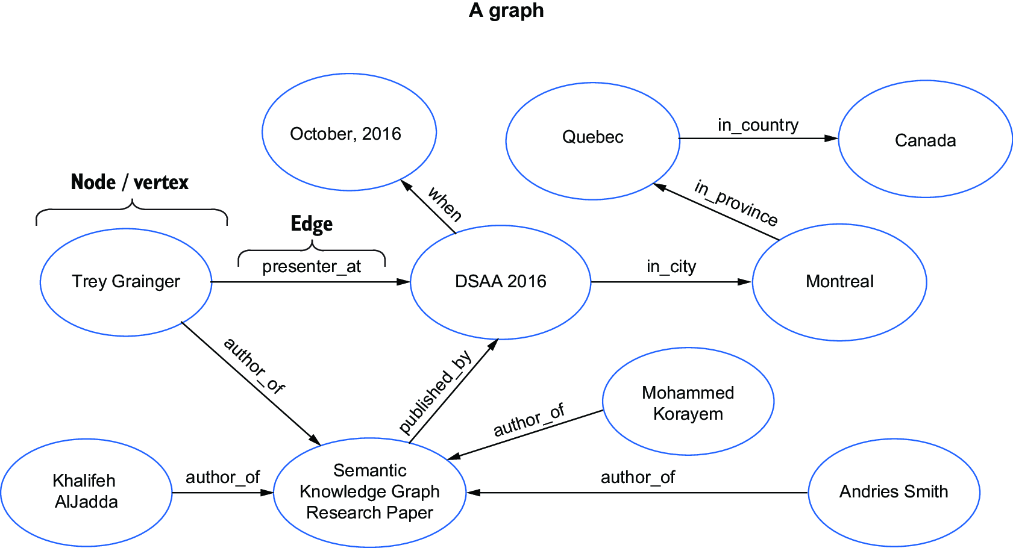
Use the graph figure to inspect how nodes and edges model entities, relationships, and inferable connections. section 5.1

















