A long task list can keep you constantly busy without producing meaningful progress. The Eisenhower Matrix restores focus by separating urgency—what demands immediate attention—from importance—what advances long-term goals. section 14.3 section 14.3.1
Classify every task into one of four practical responses:
- Do: act now on tasks that are both urgent and important, such as resolving a critical regression or meeting an imminent legal deadline. section 14.3.2
- Schedule: reserve focused time for important but nonurgent work, such as redesigning an on-call process or planning a long-term project. section 14.3.2
- Delegate: transfer urgent but nonimportant work when another person can handle it, while helping that person succeed. section 14.3.2
- Delete: remove tasks that are neither urgent nor important because they distract from meaningful objectives. section 14.3.2
Figure 14.3 The four quadrants of the Eisenhower Matrix for time management
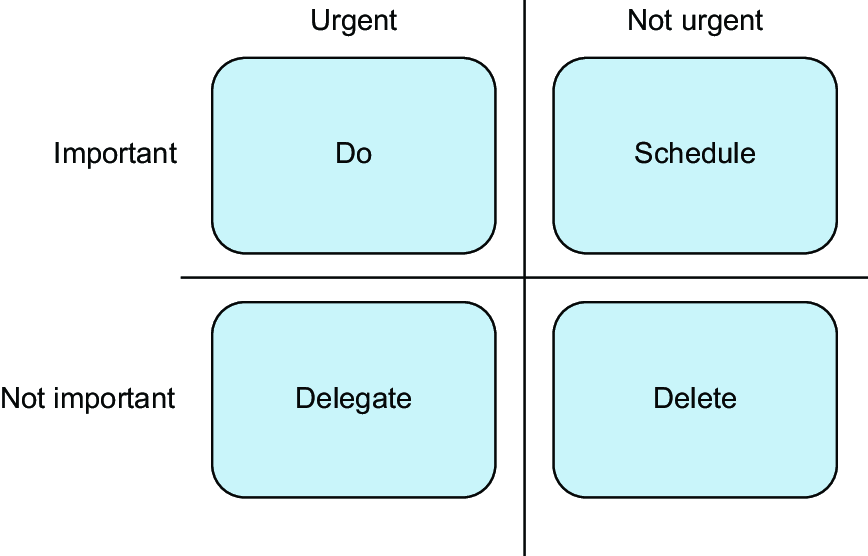
Use the four-quadrant diagram to classify tasks and compare the appropriate response at a glance. section 14.3.2
Rebalance a crowded workweek
If urgent problems consume most of the week, plan ahead to prevent avoidable crises. If urgent but unimportant requests dominate, identify contacts or train teammates for delegation. If distractions consume time, review them with stakeholders and remove those below the required importance threshold. section 14.3.3
Spend time to find time. At each day’s end, estimate time by quadrant, or record tasks in 30-minute intervals for a more precise view over one or two weeks. Use the pattern to increase Quadrant 2 work, which supports long-term goals, and reduce recurring Quadrant 1, 3, or 4 activity. section 14.3.3 section 14.5
Figure 14.4 Some real examples of the four quadrants of the Eisenhower Matrix
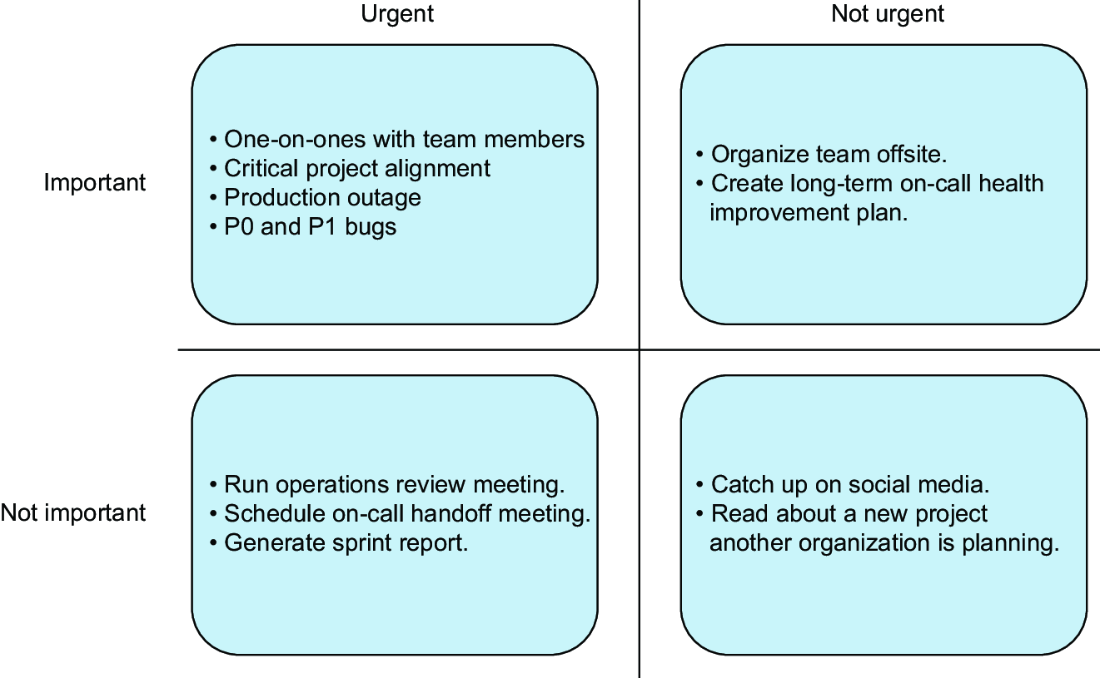
Use the example diagram to see how real tasks fit into the four categories. section 14.3.2
