End-to-end learning trains a neural network by using one loss function to guide joint adjustments to parameters throughout the network, including those that form internal representations. section 11.2
Training links prediction to parameter updates:
- A forward pass transforms inputs through successive layers to produce a prediction. section 11.2
- A loss measures prediction error; backpropagation computes gradients for weights and biases, and an optimizer uses them to update parameters. section 11.2
- After training, producing a prediction requires only the forward pass. section 11.2
Inputs, outputs, and losses
Inputs may be pixels, sensor readings, customer features, or word embeddings. Networks can predict a continuous value or class probabilities; squared error is typical for regression, while cross-entropy is typical for classification. section 11.2
Figure 11.1 A simplified feedforward neural network containing an input layer, two hidden layers, and an output layer. Information moves forward through weighted connections to produce a prediction. During training, error information moves backward so that the weights and biases can be adjusted. Modern deep networks typically contain many hidden layers and many nodes within each layer, producing millions or even billions of adjustable parameters. Despite that scale, they follow the same basic forward-and-backward process shown here.
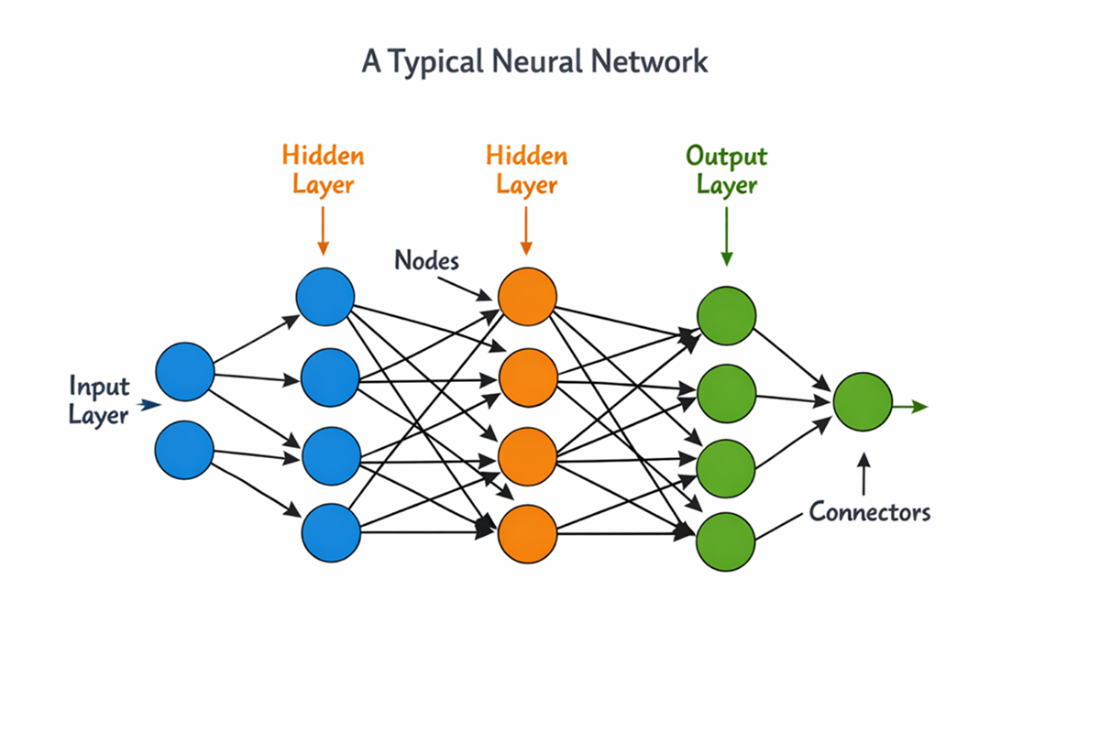
A feedforward diagram shows predictions moving forward and error information moving backward to adjust parameters. section 11.2



