End-to-end tests exercise an entire application across services. Making them a release gate ties each service deployment to a broad, multi-component test suite. section 1.3.4 section 1.3.1
In a microservice architecture, weigh the costs of running end-to-end tests before deploying a service:
- Many moving parts make the tests slow and prone to random failures. section 1.3.4
- Failures require manual review to decide whether a change is releasable. section 1.3.4
- Move end-to-end tests out of the deployment pipeline; test each service in isolation in its own pipeline. section 1.3.4 section 1.3.1
Figure 1.13 Some, but not all, operations in a microservice architecture will span multiple services. Distributed operations are more complicated to design because services are process and transaction boundaries. This creates numerous design challenges since the network is not free, it’s unreliable, and not all services are guaranteed to be simultaneously available. You must also use an unfamiliar transaction model known as eventual consistency.
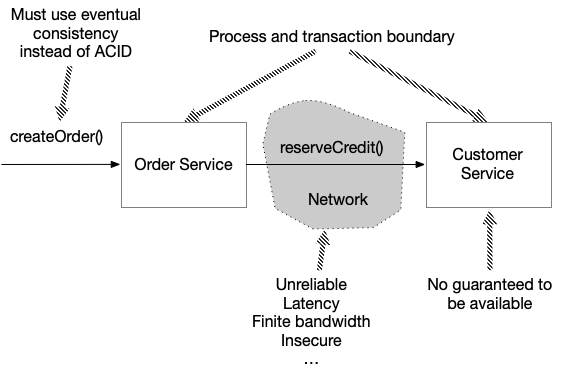
Distributed operations can span services, where unreliable networks and service availability complicate testing across boundaries. section 1.3.4