Entity resolution determines when different representations refer to the same real-world entity, allowing related documents to be joined even when their terms do not match exactly. section 2.1.3
In unstructured search data, this acts like a fuzzy foreign key. Natural language processing connects variations such as “Trey Grainger” and “Trey,” and can extend the relationship to pronouns, images, or videos that refer to the same person. section 2.1.3
Joining references to one person
One document names “Trey Grainger,” while another names “Trey.” Resolving both references to the same entity lets a search system join information across the documents. The same process may connect “he,” “his,” an image, and a video reference. section 2.1.3
Figure 2.5 Fuzzy foreign keys. In this example, the same entity is being referenced using different terms, and a join is occurring based upon multiple phrases resolving to the same entity.
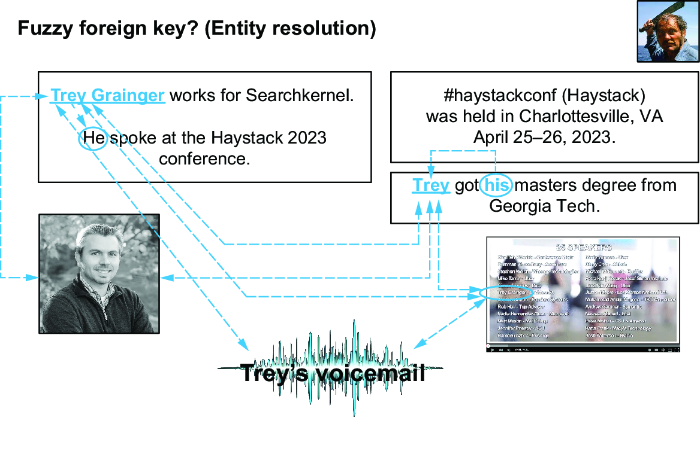
Visualizes fuzzy foreign keys by showing different phrases resolving to one entity and enabling a document join. section 2.1.3




