A customer may shop in a store, use an app, and browse a website, leaving separate records in each system. Entity resolution reconciles records that refer to the same real-world entity. For people, this is often called identity resolution: linking the right activity and contact details to one unified profile. The same problem applies to households and businesses, or accounts. section 6.1 section 6.1.2
The aim is not to merge as many records as possible. A false positive joins different entities; a false negative leaves records for one entity apart. Either can weaken targeting and personalization. A mistaken merge can also expose sensitive information or send an inappropriate message. Decide how much uncertainty is acceptable for each use case: broad prospect acquisition may tolerate more ambiguity than communications with active customers. section 6.4 section 4.4.10
A practical starting point is a matching approach the team can explain and monitor:
- Start with accurate first-party data from the relevant systems and identify a primary source of truth, often transaction data. section 6.0 section 6.1.1
- Consider deterministic rules such as single-field, composite-key, or deterministic-cascade matching. A single-field rule joins records on an exact shared value, such as a user ID or email address; it is straightforward but cannot connect activity lacking that value. section 6.1.1
- Make merge assumptions transparent and observable. Monitor for data problems before they affect campaigns, and allow corrections where matching remains uncertain. section 6.1.1 section 6.1.3
One shopper, several apparent identities
A shopper uses a loyalty account and mobile app but also buys in-store without signing in. A holiday visit adds a parent’s IP address; a gift shipment adds a friend’s address. Joining every activity at the parent’s IP address to the shopper could mistake the parent’s purchases for hers. Leaving the unsigned-in purchase separate could miss genuine activity. The matching rules must weigh both errors. section 6.1
The entity being resolved changes the decision. For household targeting, a physical address can often group people, but multiple addresses and complex relationships make errors hard to eliminate. In business-to-business marketing, separate records for one company can split engagement across accounts. If lead scoring depends on activity from several contacts at a company, that split may prevent a timely sales handoff. section 6.1.2
Figure 6.6 Account and contact one-to-many relationships
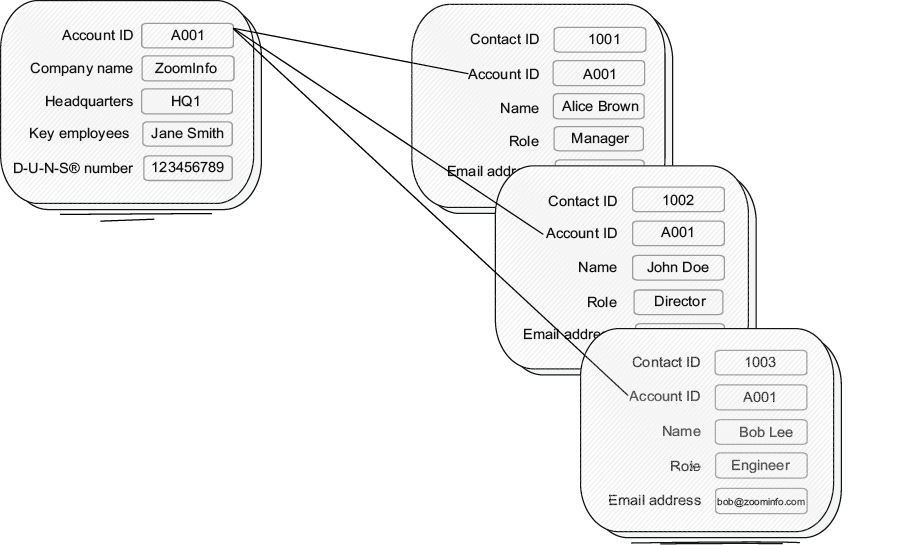
The account–contact relationship helps distinguish matching company records from matching the individual people associated with them. section 6.1.2
Technology choices should follow the team’s need for control. A customer data platform may provide built-in matching and a user interface; a composable approach can let a data team define deterministic steps in a marketing data lakehouse. For otherwise unlinked sessions, third-party identity stitching can extend reach, but external identifiers introduce privacy and consent considerations. Evaluate every option against match quality, understandable assumptions, monitoring, and the consequences of a wrong merge. section 6.1.3 section 6.3.2 section 1.3.4




