Entity resolution determines which records or mentions refer to the same real-world entity. In knowledge-graph construction, it links extracted mentions across documents, normalizes them into canonical entities, and supports coherent querying. section 4.5 section 6.1.1
A practical resolution pipeline combines progressively stronger signals:
- Extract mentions from source documents, including OCR output, and retain links to their originating pages. section 6.1 section 6.1.1
- Create candidate links when entity strings are identical or sufficiently similar, using domain-aware thresholds. section 6.1.4
- Combine contextual graph signals such as shared employers, research topics, and multiple related mentions to increase confidence. section 6.1.4
- Cluster unresolved domain entities with embeddings and hierarchical clustering when names and dictionaries are inadequate. section 6.1 section 6.3
Resolving abbreviated names
“Eleanor Smith” and “E. Smith” become stronger match candidates when both people work for the same university and share a research topic. A surname-only rule would create many false positives, so the baseline combines surname and first-name evidence with graph context. section 6.1.4
Figure 6.2 Simplified KG schema of the Rockefeller Archive Center project
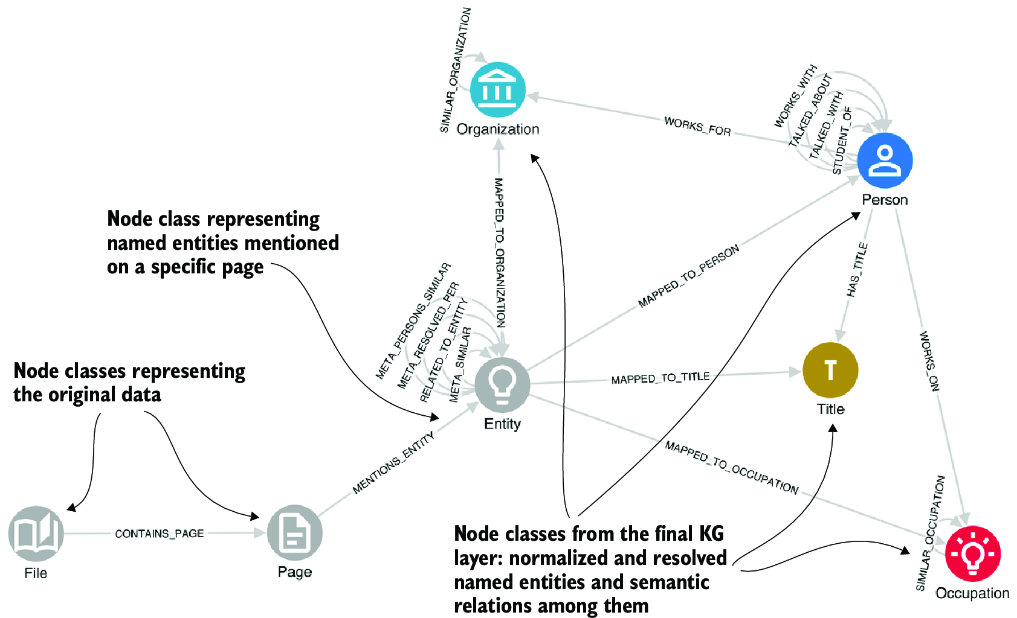
Use the schema diagram to distinguish raw documents and pages, unmerged metagraph mentions, and final resolved entities and relations. section 6.1.1
Resolution reduces ambiguity but does not eliminate it. Production systems still require validation, broader entity coverage, and possible disambiguation against a knowledge base such as WikiData. section 6.1.4 section 6.3




