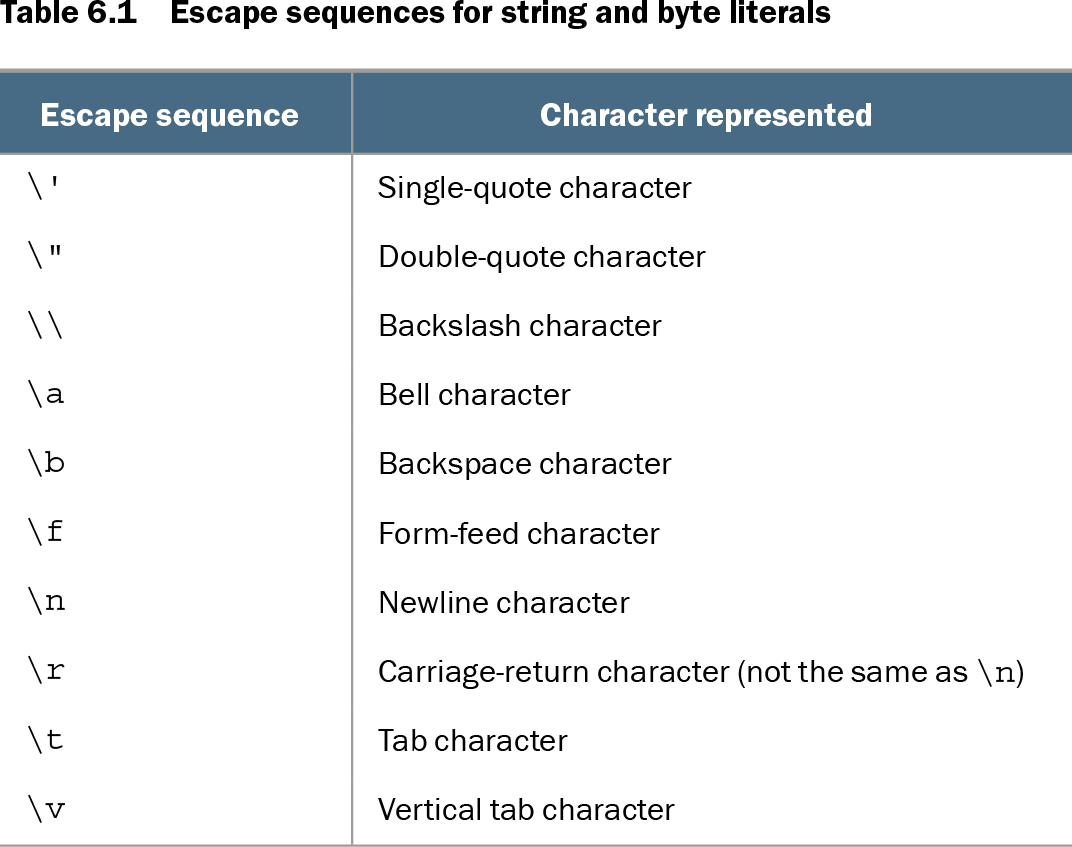
An escape sequence is a backslash-led character sequence inside a string literal that represents a special character or control function. Common examples include \n for a newline, \t for a tab, \\ for one backslash, and \" for a double quote. Escapes let strings contain characters that would otherwise end the literal or lack a printable one-character form. section 4.6 section 6.3
Use the notation that matches the character or representation required:
- \' and \" represent quote characters, while \\ represents a backslash. section 6.3.1
- \n creates a newline; \r creates a carriage return; \t creates a tab; \b, \f, \v, and \a represent other control characters. section 6.3.1
- Represent ASCII characters numerically with three-digit octal escapes such as \155 or hexadecimal escapes such as \x6D. section 6.3.2
- Represent Unicode characters by number with \u or by name with \N{Unicode name}. section 6.3.2
Escapes at two interpretation layers
Regular expressions interpret escapes after Python interprets the string literal. To search for the literal text "\\ten", a normal Python string needs four backslashes: re.compile("\\\\ten"). With only two, Python produces one backslash, and the regular-expression engine reads \t as a tab. section 16.3
Table 6.1 Escape sequences for string and byte literals (view table figure)
| Escape sequence |
Character represented |
|---|---|
| \' |
Single-quote character |
| \" |
Double-quote character |
| \\ |
Backslash character |
| \a |
Bell character |
| \b |
Backspace character |
| \f |
Form-feed character |
| \n |
Newline character |
| \r |
Carriage-return character (not the same as \n) |
| \t |
Tab character |
| \v |
Vertical tab character |
Use the compact reference table to compare quote, control-character, newline, carriage-return, tab, and backslash escapes. section 6.3.1