When a nested element is clicked, its event can reach handlers on ancestor elements too. Capturing carries the event down toward the target; bubbling carries it back up. section 13.3.1
Figure 13.16. First the event trickles down from the top, executing all event handlers in capturing mode. When the target element is reached, the event bubbles up to the top, executing all event handlers in bubbling mode.
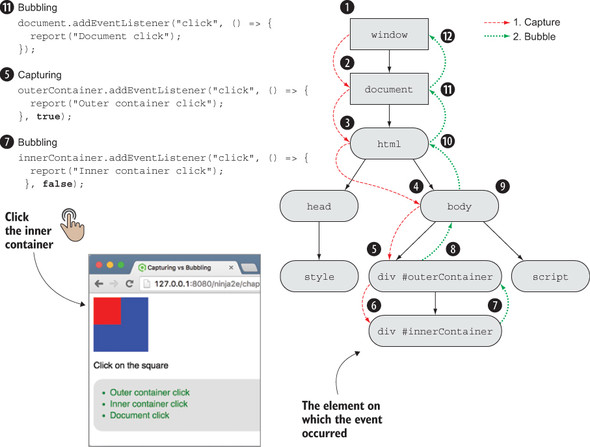
The event travels down through capturing handlers, reaches its target, then travels upward through bubbling handlers. section 13.3.1
Propagation also makes it possible to handle descendant events at an ancestor:
- In a handler, this refers to the element with that handler; event.target identifies the element where the event occurred. section 13.3.1
- Event delegation uses one ancestor handler to respond to events from its descendants, avoiding identical handlers on every element. section 13.3.1
Delegate table-cell clicks
Instead of attaching a click handler to every cell to turn it yellow, attach one to the table and use event.target to identify the clicked cell. section 13.3.1



