Evidence is information or an artifact retained to support claims and reconstruct an interaction after it is complete. In an agentic workflow, an action needs evidence, and that evidence must remain linked to the originating intent. section 6.2.2 section 6.4.1
A conversational contract makes the evidence obligation explicit alongside intent, context, constraints, authority, and outcome. It defines what must remain without prescribing every internal reasoning step. The obligation applies to tool calls, agent-to-agent tasks, human handoffs, and other interaction forms. section 6.2.2 section 6.2.1
Reconstructing a quality investigation
An agent assessing whether a production lot requires containment may assemble production and supplier records and recommend an action within its authority. A production data snapshot, supplier record version, operating envelope, and timestamp can help explain the action. A correlated contract identifier links the investigation, handoff, and human decision so a reviewer can trace what happened and who held authority. section 6.2.2 section 6.4.1
Events need not contain every artifact. They can carry identifiers, references, policy context, versions, and correlation data while evidence remains in systems of record, evidence stores, or audit services. The important boundary is navigability: a reviewer must be able to follow the chain from the originating interaction to the final action. section 6.4.1
Figure 6.4 A correlated event chain preserves the relationship among the originating interaction, authority context, next ownership, and evidence. The qualifying nonconformance signal triggers the workflow or case platform to create conversational-contract instance CC-2418, which then correlates the investigation, handoff, and human decision so the flow can be reconstructed afterward.
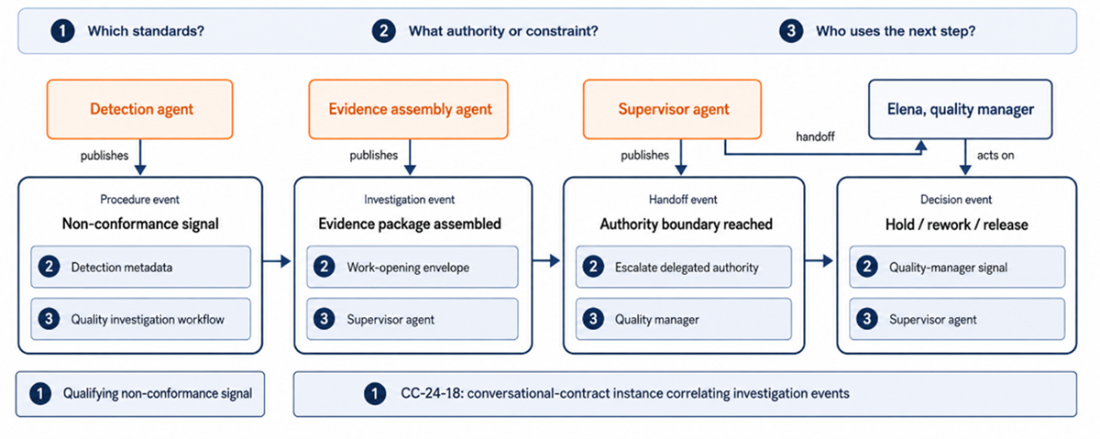
Trace how a contract identifier connects the investigation, handoff, human decision, and evidence. section 6.4.1
Usable material is not automatically authoritative evidence. Retrieval may rank a superseded clause above the applicable amendment, while transcription may make an uncertain exchange appear definitive. Retrieved passages, transcripts, and extracted fields remain candidates until qualified for the matter, purpose, and authority level; some may require lawyer review. section 5.3







