External memory, or non-parametric memory, is information stored outside a model that an agent system can save, retrieve, and update at runtime. Relevant entries are injected into the context window when needed, giving otherwise independent model calls continuity across turns and sessions. section 5.1 section 1.5.4
Unlike parametric memory embedded in model weights during training, external memory can accommodate evolving, user-specific, and task-dependent information. The application controls which information is written, retrieved, and expired. section 5.1 section 1.5.4
External memory uses two storage tiers and surfaces selected information in context:
- Ephemeral storage holds current work, including session objects and scratchpads for intermediate results. A curated view of the session is replayed on each call. section 5.1 section 1.5.4
- Persistent storage retains useful information across sessions in databases, vector databases, knowledge graphs, or files. The agent queries the store, and matching entries enter the context window. section 5.1 section 1.5.4
- A load brings persistent information into the running task; promotion writes a value from ephemeral work back for durable use. State, by contrast, represents the current status of an active workflow. section 5.1 section 5.6
Remembering a flight preference
During a session, an agent retains a user's preference for evening flights in short-term memory and applies it several turns later. If the preference is saved to persistent storage, the agent can retrieve it in a later session and use it when proposing flights. section 1.5.4
Memory management requires selective retrieval, compression, controlled writing, and consolidation. Safeguards are also needed against stale, conflicting, or poisoned memories. section 5.6
Figure 5.1 Memory in an AI agent: parametric memory inside the model, and non-parametric memory kept in persistent and ephemeral storage, surfaced in the context window as long-term memory, short-term memory, and state
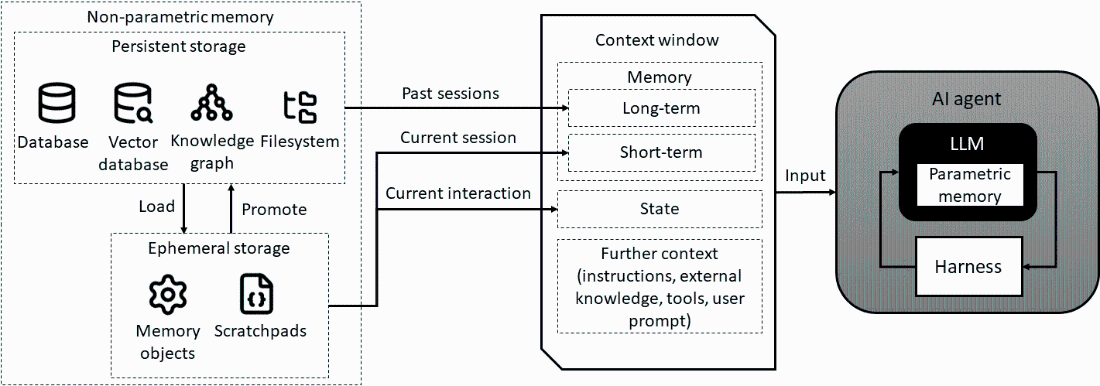
The diagram connects persistent and ephemeral storage to the memory and state blocks surfaced in an agent's context window. section 5.1

