A knowledge base is an authoritative store of organization-specific information that grounds application responses in current products, policies, and documentation rather than generic model knowledge. Production systems typically access it through a data service and retrieval workflow. section 1.1.1 section 1.5
A production knowledge-base integration supports:
- Searching policy documents semantically so user language can map to relevant organizational content. section 1.5
- Supplying retrieved content to the model alongside the user's question and conversation history. section 1.5
- Reducing unsupported answers by grounding responses in documented policies and validating them before delivery. section 1.1.1 section 1.5
Electronics return policy
For a laptop-return question, semantic search retrieves the 30-day return window, the 15% restocking fee for opened items, and requirements for receipts and original packaging. The generated answer uses these documents instead of improvising a generic return policy. section 1.5
Figure 1.4 The conversational request flow shows how Maria's simple question flows through multiple platform services before returning a response. The Workflow Service orchestrates the entire interaction, coordinating calls to the Session Service to retrieve conversation history, the Guardrails Service to validate both input and output for safety, the Data Service to search organizational knowledge, and the Model Service to generate contextually appropriate responses. The Observability Service tracks costs and performance throughout this coordinated sequence, demonstrating how platform services transform simple interactions into production-ready AI applications.
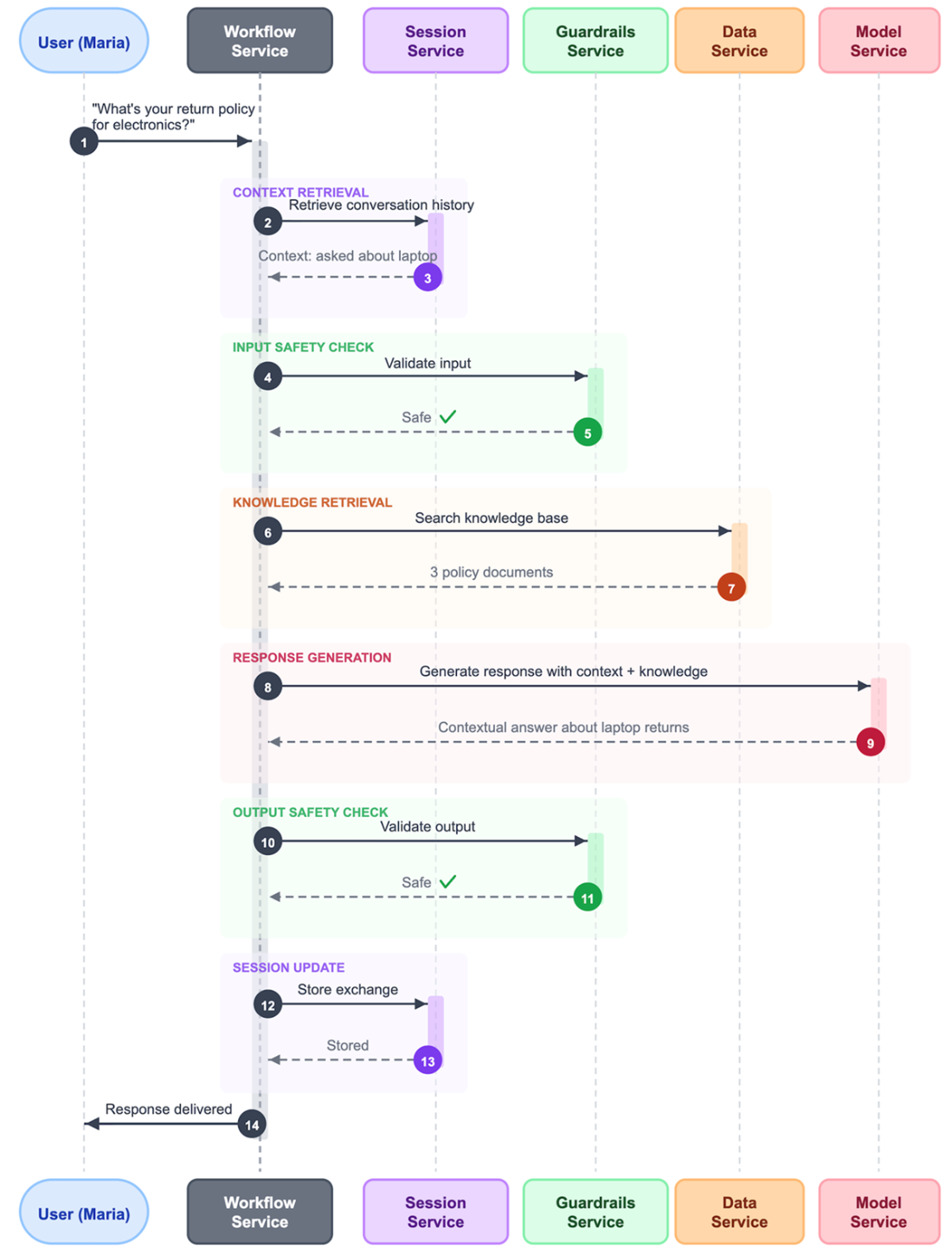
Trace how the Workflow Service coordinates session history, guardrails, knowledge-base search, model generation, and observability around one conversational request. section 1.5














