A knowledge base stores structured domain knowledge for computational use. Intelligent systems acquire knowledge from data, environments, and experts, then use it during reasoning. In an autonomous advisor, it supplies established, domain-specific understanding rather than generic answers and can grow through feedback from suggested actions. section 2.2.3 section 2.3
Knowledge bases support an implementation pipeline:
- Transform heterogeneous structured or semistructured data into explicit entities, relationships, and properties guided by ontologies or schemas. section 2.3
- Store representations for reasoning, while domain experts help define semantics, evaluate results, and maintain accuracy. section 2.3
- Apply logical statements to relevant knowledge when a deductive reasoner must act or provide suggestions. section 2.5.1
Medical diagnosis
A virtual doctor can use a knowledge base containing action costs and outcomes, disease–symptom probabilities, and patient preferences to propose tests, treatments, and queries. This approach depends on knowledge that is sufficiently complete and accurate. section 2.5.1
Figure 2.4 Extended model of an intelligent system. The focus is on the core components (the knowledge base and the reasoning engine) and the core processes (knowledge acquisition and reasoning).
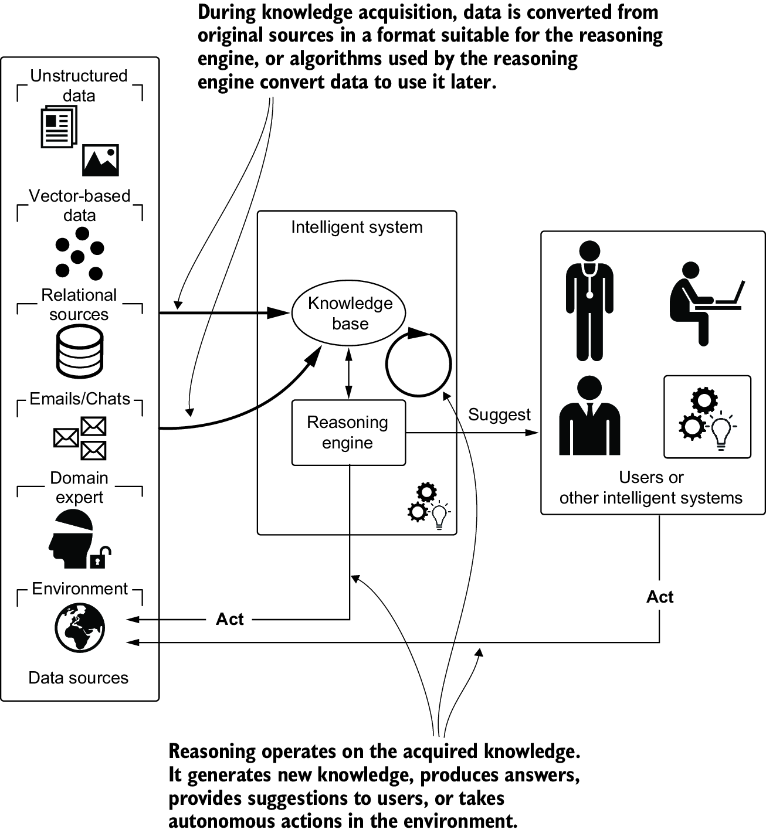
Shows the knowledge base alongside the reasoning engine, with knowledge acquisition and reasoning as the system’s core processes. section 2.2.3









