Resilience is the architectural ability to keep autonomous action safe when inputs, such as threat intelligence, are corrupted. Without safeguards, one poisoned feed could freeze an entire customer base. section 1.1
Evaluate resilience at explicit decision boundaries:
- Test whether corrupted information can trigger broad, unsafe actions. section 1.1
- Define thresholds, escalation conditions, and accountable ownership around autonomous actions. section 1.1
- Treat successful autonomous execution as insufficient evidence of architectural readiness. section 1.1
The 3 a.m. account freeze
An autonomous fraud-response agent can freeze accounts without immediate approval, but poisoned threat intelligence could cause widespread customer lockouts. Resilience requires bounded authority, escalation rules, and an accountability trail. section 1.1
Figure 1.1 Deterministic and agentic fraud response flows, showing the shift from human approval to delegated system authority and the move from hours-long governance cycles to autonomous action in seconds.
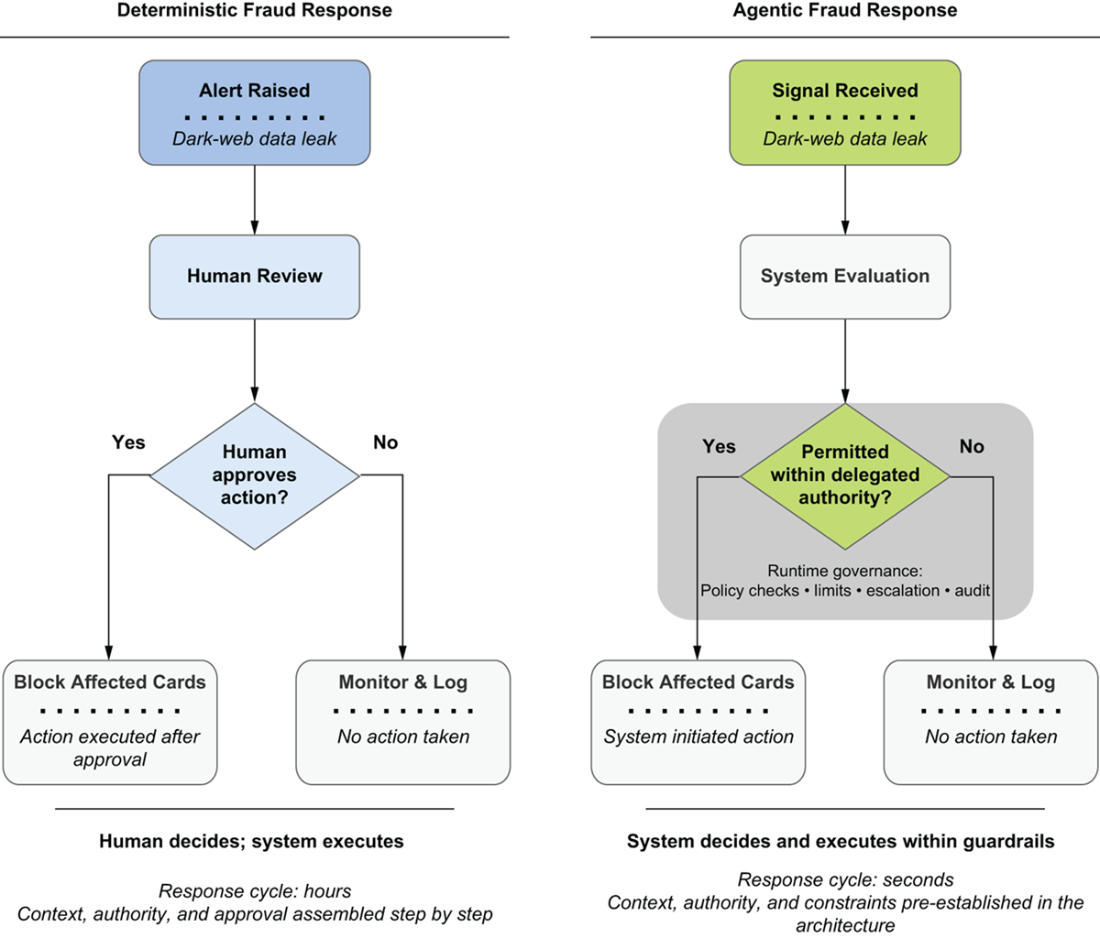
Compare deterministic fraud response with agentic response to see how delegated authority compresses governance time and increases resilience requirements. section 1.1
















