A feature store makes curated features available for both model training and inference. Instead of each team rebuilding transformations or maintaining its own retrieval queries, a shared feature registry catalogs what is available. Using the same managed features across training and serving helps prevent training-serving skew. section 1.3.3 section 4.1.3
Feast fits after feature computation: a pipeline produces transformed feature data in an offline store, such as a MinIO bucket, while Feast registers feature definitions and provides retrieval methods. Keeping feature generation separate from modeling makes the resulting features easier to share and reuse. section 4.2
Figure 4.10 Feast feature store design involves a feature pipeline populating the offline store and periodically Feast materializes the offline features to the online store. The feature registry holds feature definitions along with online and offline store information. The Feast SDK provides methods to retrieve features from online and offline stores, which can be used for training and inference purposes.
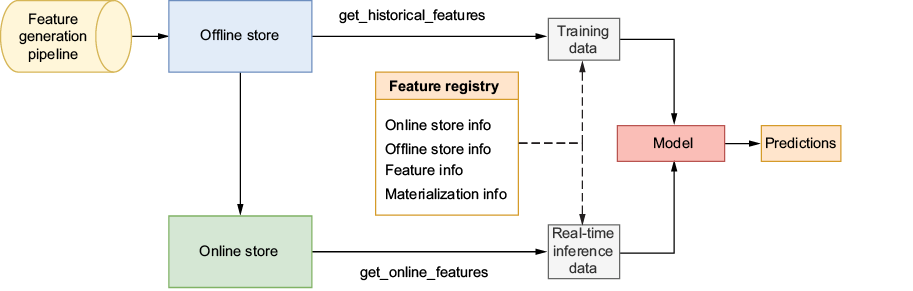
The diagram separates the feature pipeline, offline store, online store, registry, and Feast SDK. Follow the path from computed features to historical retrieval for training or low-latency retrieval for inference. section 4.2
Retrieve features as they existed at the time
Suppose a user has feature records dated January 7, May 21, and December 4. For a May 22 retrieval, the appropriate record is May 21—not the later December record. Feast can produce point-in-time-correct feature sets without a separate SQL join or retrieval script. section 4.2
Choose retrieval according to the workload:
- Use an offline store for historical features during training or batch inference. section 1.3.3 section 4.3
- Materialize offline features into an online store, such as Redis, when real-time inference needs low-latency retrieval. section 4.2
A feature store complements rather than replaces the rest of the ML platform: MLflow tracks experiments and registers models, while Feast manages their features. The Feast UI can show registered features, entities, and data sources. Updating features and retraining models still require orchestration; registration alone does not automate those jobs. section 4.0 section 4.2.4




