liveBook · Manning

Feature vector

As explained in Applied Reinforcement Learning

A feature vector is an ordered collection of numerical features representing an input state or state-action pair.

A feature vector is an ordered collection of numbers that represents a state—or a state–action pair—in a form a learning algorithm can use. Feature extraction keeps selected aspects of the raw input and discards detail for tractability. In linear function approximation, each feature is multiplied by a weight, and the weighted values are summed to estimate a state–action value. section 8.1

Figure 8.3 Linear function approximation with temporal-difference learning
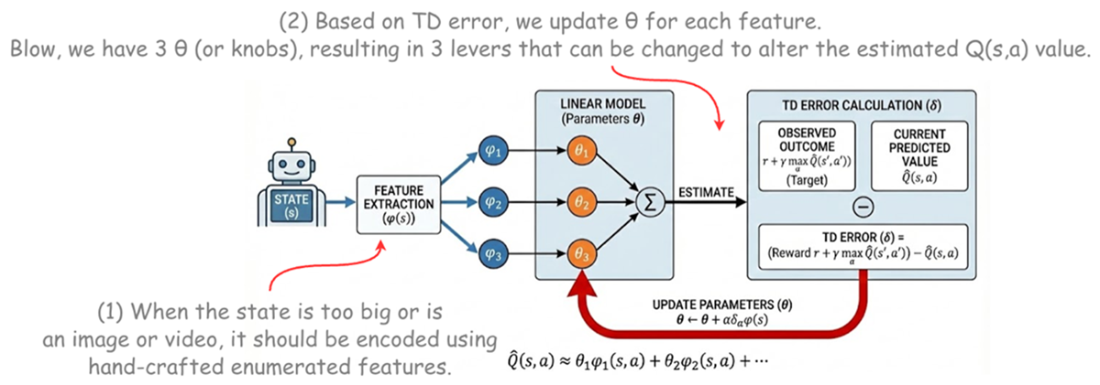
See how features feed a linear value estimate and connect to temporal-difference learning. section 8.1


How Applied Reinforcement Learning covers it

How deep it goes
Defines feature extraction and its role in a weighted sum, but does not detail how to design features.
Examples
Names images, waveforms, patient records, and sensor vectors as possible raw states.
What you can do after
Understand how selected numerical features let a linear model estimate a state–action value.
How it connects
Connects feature extraction to linear function approximation, Q-values, and temporal-difference learning.

Also explained in

Compare how 5 books explain feature vector →

Related concepts

This explainer was generated by Manning's knowledge graph from the text of Applied Reinforcement Learning. The section links point to the parts of the book it draws on.


