A Fourier transform represents a signal or function through its frequency components, making complex data easier to analyze, filter, compress, and reconstruct. section 1.0 section 7.1.1
The practical intuition is additive: multiple sinusoidal waves form a complex signal, while frequency decomposition separates those components for digital storage and later recombination. section 7.1.1
A computational treatment proceeds through a small signal-processing workflow:
- Model a continuous sinusoidal wave using time, amplitude, phase, and frequency. section 7.1.1
- Convert the continuous signal into equally spaced discrete samples suitable for digital computation. section 7.1.1
- Visualize the sampled values alongside the underlying wave to inspect how the discrete representation captures the signal. section 7.1.1
- Relate classical Fourier transforms to the fast Fourier transform and to quantum Fourier transform algorithms. section 1.0 section 7.3
Eight samples of a sound-like wave
Set N = 8 and frequency = 1.7, then generate eight cosine samples with Python. Plotting the continuous-looking wave and the sampled points reveals approximately 1.7 cycles across the eight time intervals. section 7.1.1
A glass harmonica and the composition of waves
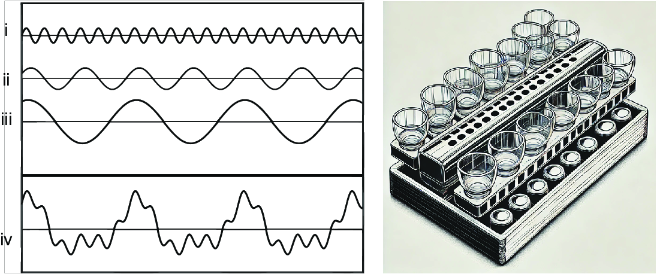
Use the glass harmonica illustration to visualize how simultaneous standard-frequency sounds combine into a complex wave. section 7.1.1

