Frequency measures how quickly a wave’s electric and magnetic fields oscillate: it is the number of complete oscillations per second. The unit is hertz (Hz). section 18.2.1
Use these units and distinctions when interpreting wireless signals:
- 1 kHz equals 1,000 cycles per second; 1 MHz equals 1,000,000; 1 GHz equals 1,000,000,000; and 1 THz equals 1,000,000,000,000. section 18.2.1
- Amplitude describes signal strength and energy, whereas frequency describes oscillation rate; waves can have different frequencies but identical amplitudes. section 18.2.1
- Period is the time required for one complete oscillation. A 4 Hz wave completes four oscillations per second, giving a 0.25-second period. section 18.2.1
- In wireless LANs, higher frequencies typically support higher data rates and face less crowding but are absorbed more readily by obstacles; lower frequencies penetrate better and cover farther. section 18.5
Four-hertz wave
A wave operating at 4 Hz completes four full oscillations every second. Each oscillation takes 0.25 seconds, so its period is 0.25 seconds. section 18.2.1
Figure 18.6 Waves with higher frequency oscillate at a greater rate. Frequency is measured in hertz (Hz), which is the number of oscillations per second.
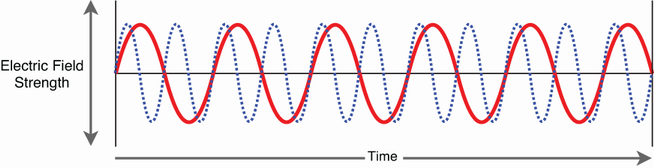
Compare waves by counting how many oscillations occur in the same time interval; the wave with more oscillations has the higher frequency. section 18.2.1






