Frequency measures repetition: a sinusoid’s frequency is the number of cycles completed in a chosen interval. A wave also has amplitude, its peak height, and phase, its horizontal shift. Composite sounds can be treated as mixtures of simpler sinusoids with different frequencies. section 7.1.1
Figure 7.3 The sinusoidal wave sin(x) for real values x has amplitude 1, phase 0, and frequency 1.
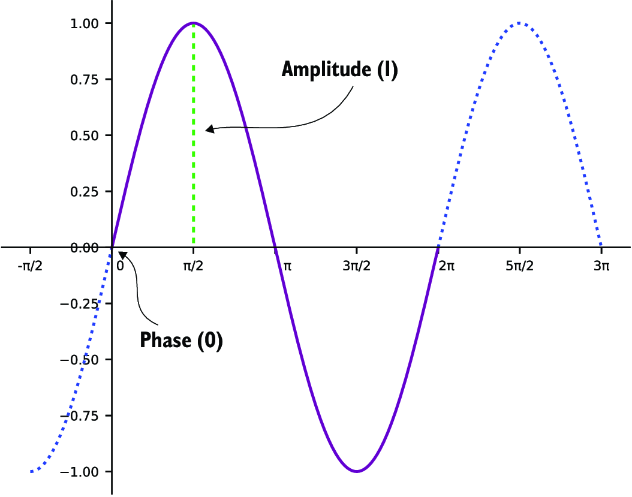
The plotted sine wave makes the three independent properties visible: frequency counts cycles, amplitude sets height, and phase sets horizontal position. section 7.1.1
For N discrete samples, frequency can be represented by how quickly values rotate through a sinusoid. A sampled cosine may use cos(2πv(t/N)), where v is the frequency parameter and t is the sample index. Frequencies need not be whole numbers: changing v changes the rate at which the sampled pattern progresses. section 7.1.1
A quantum state cannot encode a single real sinusoid directly when its amplitudes must have squared magnitudes summing to 1. Instead, a normalized complex sinusoid uses amplitudes 1/√N · cis(kθ), where cis(θ) = cos(θ) + i sin(θ). The amplitude at outcome k has phase kθ, and θ/(2π) = v/N. Frequency is therefore visible as the number of turns around the unit circle while stepping through the outcomes. section 7.1.2
Eight amplitudes with frequency 4/3
With three qubits, N = 8. Set θ = π/3 and assign amplitude k as 1/√8 · cis(kπ/3). Each step advances one-sixth of a full turn; eight steps make 1⅓ turns, so v = 4/3. Phases repeat after outcome 6 because sine and cosine are periodic. section 7.1.2
Figure 7.8 Unit color wheel representation of the geometric sequence state for θ = π/3
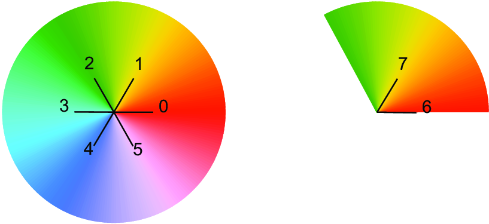
The color wheel turns phase increments into a visual frequency count: follow the amplitudes around the circle and count total rotations. section 7.1.2
Fourier basis states are normalized geometric-sequence states indexed by frequency l. The inverse quantum Fourier transform computes each output amplitude as an inner product with the corresponding Fourier basis; the QFT uses bases with negative frequency indices, equivalently conjugate rotations. These transforms reorganize a state by its frequency components. section 7.3.2
Frequency estimation of periodic quantum states leads into quantum phase estimation. QPE is used as a building block by other quantum algorithms, including Shor’s algorithm, and is connected to estimating circuit rotation angles and to quantum amplitude estimation. section 9.0






