A Gaussian process is a statistical model that predicts values while providing a probability distribution describing prediction certainty. In search, it helps balance exploiting a ranking model’s known strengths with exploring poorly understood query–document combinations. section 12.3.2 section 12.3
Think of exploration as surveying a river with only scattered depth measurements. Nearby dates are easier to predict and safer to exploit; distant, unobserved dates carry more uncertainty and may reveal useful knowledge, but also introduce risk. A Gaussian process estimates both expected outcomes and uncertainty so exploration can target promising gaps. section 12.3.2
A search exploration pipeline can use a Gaussian process as follows:
- Train GaussianProcessRegressor on logged feature combinations and their observed relevance grades. section 12.3.2
- Generate candidate combinations of ranking features, such as name matching, description matching, and promotion status. section 12.3.2
- Predict each candidate’s grade and standard deviation, retaining both expected performance and uncertainty. section 12.3.2
- Calculate expected improvement from opportunity, probability of improvement, and predictive uncertainty, then rank candidates for exploration. section 12.3.2
Selecting an unexplored product
For the query "transformers dvd", logged judgments train the model on available ranking signals. The exploration score favors a feature vector with useful expected improvement, and the search engine retrieves a product matching that vector. One selected result is "Transformers: The Complete Series [25th Anniversary ...]" with UPC 826663114164. section 12.3.2
Figure 12.5 Exploring a river, with uncertainty of the river’s depth increasing as we get further away from past observations. How would we pick a time of year that is both safe and maximally increases our knowledge of the river’s depth?
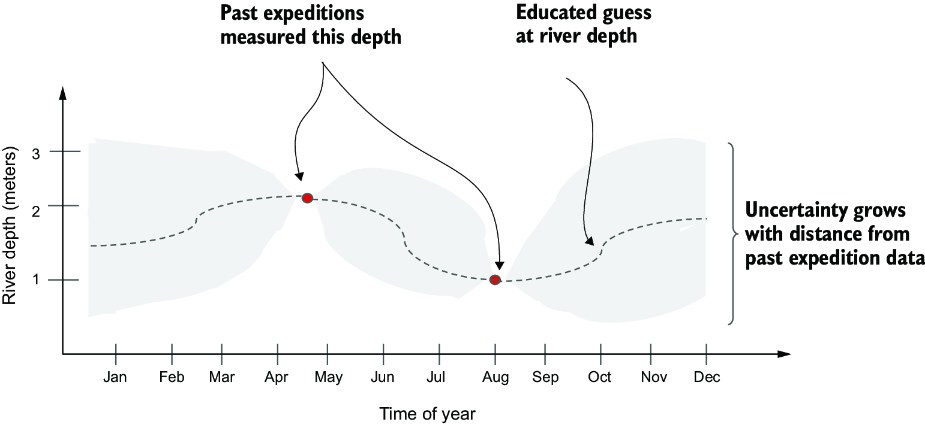
Use the river-depth figure to compare safe exploitation near known observations with riskier exploration where predictive uncertainty grows. section 12.3.2


