A generative adversarial network (GAN) creates synthetic data through two competing neural networks: a generator produces examples, while a discriminator judges whether examples are real or generated. This adversarial training is especially suited to complex, diverse data requiring high realism, including images for design, art, augmentation, and style transfer. section 4.1 section 4.1.2
A typical GAN image-generation loop works as follows:
- Feed a prompt, such as text or a sketch, together with random noise into the generator. section 4.1.2
- Produce an image intended to match the prompt and appear authentic. section 4.1.2
- Let the discriminator compare generated and real images associated with the prompt and assign a realism score. section 4.1.2
- Update both networks through backpropagation and gradient descent, repeating the competition until generated images can fool the discriminator. section 4.1.2
Enhancing medical imagery
A GAN can support super-resolution workflows by making medical images more detailed and clearer. The generator proposes an enhanced image, while the discriminator evaluates whether it resembles a real high-resolution image. section 4.1.2
Figure 4.5 GAN model architecture
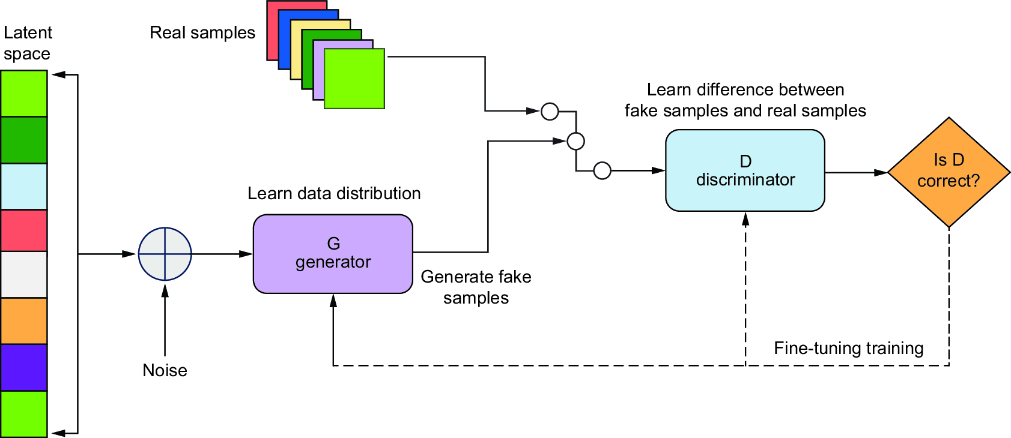
Use the architecture figure to inspect the generator, discriminator, latent space, and parameter fine-tuning at a high level. section 4.1.2











